Driving in Canada as a French driver
Canada drives on the right, the same as France. With a French licence an International Driving Permit isn't always asked for, but it's worth carrying one. Many junctions have a stop sign on every approach, and cars go in the order they stopped. You can turn right on a red light after stopping, unless a sign says not to.
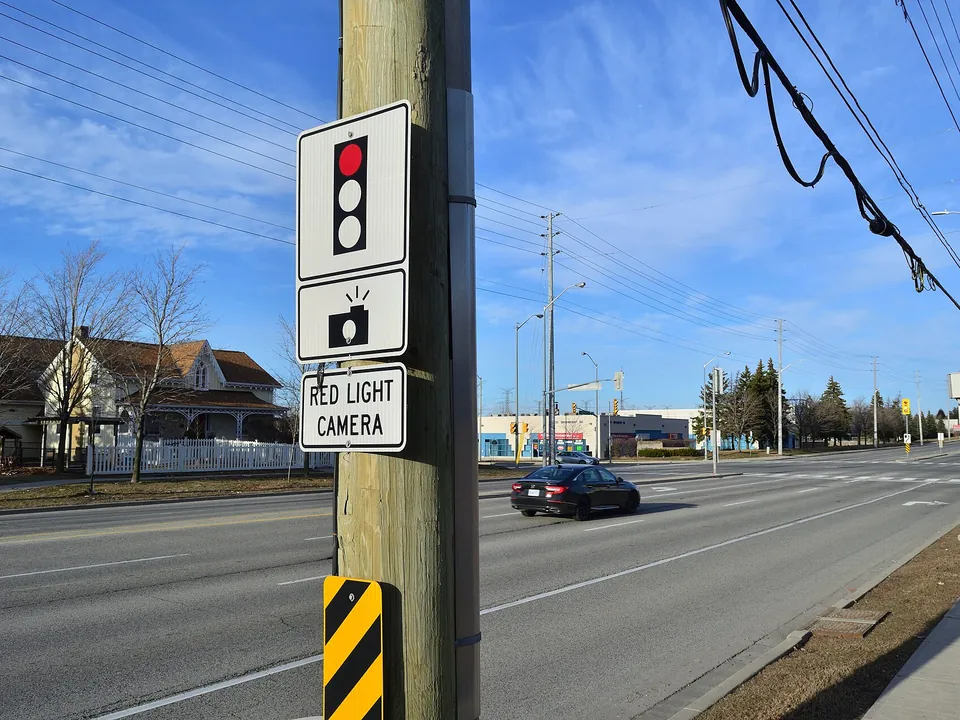
Unless signposted otherwise, the limits are usually 50 km/h in towns, 80 on country roads and 100 on motorways. Watch for fixed, mobile and red light cameras.
Canada and France side by side
The rows in yellow are different from home.
| Rule | Canada | France |
|---|---|---|
| Drive on the | Right | Right |
| Speed units | km/h | km/h |
| Alcohol limit | 0.05 | 0.05 |
| Holding a phone | Banned | Banned |
| Turn on red | Yes, after stopping | No |
| Unmarked junctions | Traffic from the right | Traffic from the right |
| Roundabouts go | Anticlockwise | Anticlockwise |
| Passing on the inside | Allowed | Banned |
The rules that catch French drivers out
The most important first.
Right turn on red, except in Montréal
You may turn right on a red light after a complete stop, once pedestrians and traffic have passed, unless a sign forbids it. On the island of Montréal it is banned at every light.
All-way stops
At an all-way stop, every driver must stop. The first car to stop completely goes first. If two cars stop at the same time, the one on the left lets the one on the right go first. You won't have met these at home, and they're common.
Stop for school buses in both directions
When a school bus has its red lights flashing or its stop arm out, traffic behind it and traffic coming towards it must stop. Only a median between you and the bus lets oncoming traffic keep going. In Ontario, stop at least 20 metres behind it.
Stunt driving in Ontario
Driving 40 km/h or more over a limit below 80, 50 km/h or more over any limit, or 150 km/h anywhere is stunt driving. Police suspend your licence for 30 days and impound the car for 14 days at the roadside, even a hire car.
Alcohol penalties start at 0.05
The criminal limit is 0.08, but Ontario and Alberta suspend your licence on the spot from 0.05, and Alberta also seizes the car. New and young drivers must have no alcohol at all. Quebec has no penalty below 0.08 for fully licensed drivers.
Winter tyres in Quebec and British Columbia
Quebec requires winter tyres on Quebec-registered cars, including hire cars, from 1 December to 15 March. British Columbia requires winter tyres or chains on most highways from 1 October to 30 April, and drivers without them can be turned back and fined.
Moose and deer
Collisions with moose and deer are a growing problem. If you see one, slow down and sound your horn, watch for others with it, and don't try to drive around it. Report any collision to the police.
13 more rules worth knowing
Carry an International Driving Permit
With a French licence, carry an International Driving Permit (IDP) with your licence. It isn't always asked for, but it's the safe choice. Alberta strongly recommends an IDP with a licence that is not in English, and Quebec recommends one with a licence not in French or English. Licences in French are fine in Quebec. Carry the IDP together with your licence.
French signs in Quebec
Quebec law requires road signs in French, though most use symbols. A stop sign says ARRÊT, and Préparez-vous à arrêter on a yellow sign warns that the traffic lights ahead are about to turn red.
Pull over for emergency vehicles
When an emergency vehicle comes with lights or siren, pull over to the right and stop. When passing one that is stopped, or a tow truck with flashing lights, slow down and move over a lane if you can.
A flashing green light means you may turn left
A flashing green light or a green arrow gives you priority to turn left. On a plain green light, give way to oncoming traffic before turning left.
Streetcars in Toronto
When a streetcar stops to let passengers on or off, stop at least 2 metres behind its rear doors. Overtake streetcars on the right unless the road is one-way.
Speed limits
Motorways are 100 km/h here, slower than the 130 km/h at home.
Passing on the right is legal
On multi-lane roads, cars can pass on either side, so check both mirrors before you change lanes.
What the car must carry
The car must carry winter tyres in Quebec (in winter) and winter tyres or chains in British Columbia (in some areas). Hire cars should have them, but check before you drive away, because the driver gets the fine.
Island of Montréal
No right turn on a red light anywhere on the island. Where: Every street on the island of Montréal. Fine: $100 to $200 and 3 demerit points. Signs at the bridges, tunnels and airport mark the start of the ban. Wait for the green light.
School zones in Quebec
The limit can be no higher than 50 km/h on school days, 7 a.m. to 5 p.m., Monday to Friday, September to June. Where: Around schools, marked by yellow-green pentagon signs. Fine: Speeding fines are doubled. A sign with the word Fin marks the end of the zone.
Construction zones
Lower limits apply. In Ontario speeding fines double when workers are present, and in Quebec they double in roadwork zones. Where: Roadworks across Canada, marked by orange signs. Fine: Double the normal speeding fine. Slow down as soon as you see orange signs.
Toll roads
Most Canadian roads are free. The main toll road is Highway 407 ETR north of Toronto, which has no booths and bills by number plate. Quebec has two toll bridges, and a few bridges elsewhere charge at booths. Highway 407 ETR runs 108 km from the QEW in the west to Brock Road in the east. Cameras read the plate. Without a transponder you pay a camera charge for each trip and an account fee for each month you use it. For a hire car, 407 ETR bills the hire company, which bills you under your rental agreement with its own fees. The bill can arrive months after the trip. Ask the hire company how it handles 407 tolls before you use the road.
Priority to the right
At a junction with no signs, signals or road markings, give way to traffic coming from your right, even from a small side street. It's the same rule as at home. At a junction with no signs or signals, if two vehicles arrive at the same time, the one on the right goes first.
Open Canada in the app, set to a French licence, and keep all of this with you offline.
Open it in the appSpeed limits compared with home
The black marks show your limits at home.
Who goes first
Priority to the right
First to stop goes first
Signs that look different from home
Speed limit
The highest speed allowed, in km/h.
Photo radar
A fixed or mobile photo radar is nearby, or may be in the area (Quebec).
Railway crossing
Railway tracks cross the road here.
Roadworks
You are entering a construction zone.
Prepare to stop
When the amber lights flash, the traffic lights ahead are about to turn red.
Pedestrian crossing
A marked crossing for pedestrians.
Sharp bend chevron (Quebec)
The road bends sharply in the direction of the chevron.
Signs you won't know from home
Traffic from every direction at this junction must stop.
Shows which other directions also have to stop. With an octagon on all four roads, everyone stops.
You are entering a school zone.
You may not turn right while the light is red.
Deer regularly cross this road.
Moose cross this road.
Traffic flows only in the direction of the arrow.
On an uphill climbing lane in Quebec, use the right lane unless you are overtaking.
Gives directions and distances.
Speed cameras
Cameras depend on the province. Ontario banned municipal speed cameras from 14 November 2025 but still uses red light cameras. Quebec uses fixed and mobile photo radar, announced by green signs showing a camera, plus red light cameras. British Columbia has intersection cameras that catch red light running and, at some sites, speeding. Alberta allows photo radar only in school, playground and construction zones, not on provincial highways. Radar detectors are illegal in Ontario, Quebec and most other provinces, but legal in British Columbia, Alberta and Saskatchewan. Camera tickets go to the vehicle's registered owner, which for a hire car is the hire company. In British Columbia and Quebec they carry no demerit points. Check your hire agreement for how fines are passed on.
Before you drive
- Your driving licenceThe physical card, not a photo or a digital licence.
- An International Driving PermitRecommended with your licence. Get it before you leave home.
- Your passportHire companies and police ask for ID.
Driving in Canada soon?
Get the before-you-drive checklist for Canada by email, with what to carry, what to check on the hire car, and the rules people get fined for.
The checklist now, one more email a few days later, and a reminder before you drive if you add the date. Unsubscribe any time.
Where French drivers drive next
Canada for drivers from elsewhere
Sources: the official Canada sources listed on the Canada guide, checked 15 October 2026.