Driving in France: the road rules for visitors

Checked 15 October 2026 against official sources

In France you drive on the right, with the steering wheel on the left, and roundabouts go anticlockwise. At junctions without signs or road markings, traffic from your right goes first, even from a small side street.

Watch for fixed, mobile, average speed and red light cameras, and for unmarked camera cars. Earphones and headphones are banned while driving.

RightSide of the road
50km/h in towns
80km/h on country roads
130km/h on motorways
0.05blood alcohol limit
Noturning right on red
Bannedearphones while driving
112emergency number

The rules that catch visitors out

The most important first.

  1. Priority to the right

    At a junction with no signs, lights or markings, traffic coming from your right goes first, even from a small side street. A red-bordered triangle with a black X warns of such a junction. On roads with yellow diamond signs you have priority until a diamond crossed by a black bar.

  2. No turning on red

    A red light means stop, whichever way you are turning. You may only pass a red light when a flashing amber arrow beside it points the way you are going. Running a red light costs €135, and red light cameras are never signposted.

  3. Nothing in your ears

    Drivers may not wear anything in or on the ear that plays sound, including a single earbud or a Bluetooth headset, even for calls. Use the car's built-in system instead. The fine is €135.

  4. Lower limits in the rain

    In rain or other precipitation the limits drop to 110 km/h on autoroutes and 100 km/h on divided roads. When visibility is under 50 metres the limit is 50 km/h on every road.

  5. Unmarked camera cars

    Ordinary-looking cars, some driven by private companies, measure the speed of traffic around them while driving. Their flash is infrared, so you will not see it. They allow a margin of 10 km/h or 10 per cent.

  6. 50 km/h over is a crime

    Driving 50 km/h or more over the limit is a criminal offence (délit) from the first time, with a fine of up to €3,750, up to 3 months in prison and possible confiscation of the car.

  7. Paris Centre limited traffic zone (ZTL)

    Driving through the zone without stopping is banned 24 hours a day, 7 days a week. You may drive in if your trip starts or ends inside the zone. Where: Paris Centre, which is the 1st, 2nd, 3rd and 4th arrondissements. The Grands Boulevards on the north side, the Île de la Cité, the Île Saint-Louis and the right-bank quays in the west to east direction are outside the zone. Fine: None yet. On 28 September 2026 the city said no fines were being issued during a teaching phase. Plan your route around the zone unless your trip starts or ends inside it.

10 more rules worth knowing

Roundabouts go anticlockwise

Go anticlockwise and give way to traffic already on the roundabout, which comes from your left. Some older roundabouts have no give-way signs or markings at the entries. There, drivers on the roundabout must slow down and let entering traffic in.

Paris has its own limits

Most Paris streets are 30 km/h and the boulevard périphérique is 50 km/h. At weekday peak times its left lane is reserved for vehicles carrying at least two people when a white diamond is lit. Through traffic is banned in the 1st to 4th arrondissements.

Camera apps yes, detectors no

Phone and GPS apps may warn of danger zones, but not of exact camera positions. Radar detectors are illegal, with a fine of up to €1,500, and the device is seized.

Speed limits

The sign with the town's name on it sets the town limit by itself, usually with no speed sign. Limits drop when it rains.

No passing on the right

On motorways, overtaking on the right is banned. Keep to the right-hand lane unless you're overtaking. Overtake on the left.

Crit'Air low emission zones (ZFE-m)

A Crit'Air sticker is compulsory to drive in a ZFE-m, and each zone bans older vehicles by sticker class on its own timetable. In Greater Paris, cars without a sticker or with Crit'Air 5, 4 or 3 cannot drive from Monday to Friday, 8am to 8pm, except on public holidays. Parliament voted to abolish the zones, but the Constitutional Council struck that out on 21 May 2026, so they remain in force. Where: 25 urban areas, including Greater Paris, Lyon, Grenoble, Strasbourg, Lille, Montpellier, Toulouse, Aix-Marseille, Nice, Rouen and Bordeaux. Entry is marked by a zone sign (B56). Fine: €68 fixed fine, up to €450. Check that the hire car shows a Crit'Air sticker on the windscreen. For a foreign-registered car, order the sticker only from certificat-air.gouv.fr, the one official site.

Winter equipment zones (Loi Montagne)

From 1 November to 31 March, cars must have four winter tyres with the alpine symbol, or carry snow chains or snow socks for at least two driving wheels. Where: Designated communes in the Alps, Corsica, the Massif Central, the Jura, the Pyrenees and the Vosges, marked by entry and exit signs (B58 and B59). Ask the hire company for winter tyres or chains if you will drive into the mountains in winter.

Toll roads

Many autoroutes charge a toll. Most are paid at toll plazas, but the A79 and the Paris to Normandy A13 and A14 use free-flow tolling with no barriers. On free-flow sections, cameras and sensors record your plate when you enter and leave. Signs warn you about 2.5 km before the entrance. Without a toll tag, pay within 3 days of the trip on the operator's website (Aliae for the A79, Sanef for the A13 and A14) or by card or cash at a shop in the Nirio network. If you don't, fines of €90 and then €375 follow.

Vest and triangle in the car

Every car must carry a hi-vis vest and a warning triangle. Wear the vest when you get out after a breakdown, and place the triangle at least 30 metres behind the car.

Drink driving

The blood alcohol limit is 0.05, and 0.02 for drivers on a probationary licence (permis probatoire), which is a first licence, usually held for 3 years or less, or one obtained again after cancellation. Learners in supervised driving have the same limit. The standard limit is 0.5 g/L of blood, or 0.25 mg/L of breath. The novice limit is 0.2 g/L of blood, or 0.10 mg/L of breath.

Speed limits

Where no sign says otherwise, in kilometres per hour.

50
Towns and cities
Applies in built-up areas (agglomération) unless a sign shows otherwise. Most streets in Paris are 30 km/h.
80
Country roads
Two-way roads without a central separator. The local road authority can raise a road to 90 km/h, and signs then show 90.
110
Dual carriageways
100 in the wet. Roads with two carriageways separated by a central reservation.
130
Motorways
110 in the wet. Autoroutes.
  • The wet limits apply in rain and other precipitation.
  • The town name sign at the entrance (EB10) marks the start of the built-up area, where 50 km/h applies without a separate speed sign.
  • Probationary drivers (a licence held for 3 years or less) have lower limits: 110 km/h on autoroutes (100 km/h where the autoroute limit is below 130), 100 km/h on divided roads, 80 km/h on sections with two lanes in the same direction, 80 km/h on two-way roads and 50 km/h in towns.
  • Driving 50 km/h or more over the limit is a criminal offence (délit) under a decree of 22 December 2025.

Who goes first

Look left first

YouFrom your leftFrom your right
You stop at the stop line.
Traffic keeps to the right here, so the lane nearest you carries cars coming from your left. Look left, then right, then left again before you pull out.

Priority to the right

YouGoes first
Both cars arrive at a junction with no signs or lines.
At a junction with no signs, signals or road markings, the car coming from your right goes first, even from a small side street.

When your road has priority

YouGives way
You are on a priority road, shown by the yellow diamond.
The yellow diamond means your road has priority and side roads have a give way line. Watch for the same diamond with a black bar across it, which means priority to the right is back.

The app animates all 8 junctions for France, including the ones above.

Open it in the app

Signs to know

Junction with priority to the rightIntersection avec priorité à droite (AB1)

A junction ahead where you must give way to traffic coming from your right.

Priority roadRoute prioritaire (AB6)

You are on a priority road. Traffic from side roads must give way to you at every junction.

End of priority roadFin de route prioritaire (AB7)

End of the priority road.

Give wayCédez le passage (AB3a)

Give way to traffic on the road you are joining. You do not have to stop if the way is clear.

STOPStopStop (AB4)

Stop at the line, then give way.

Roundabout aheadCarrefour à sens giratoire (AB25)

Roundabout ahead. Where the entry has give-way signs, traffic already on the roundabout has priority.

NEVERSTown entryEntrée d'agglomération (EB10)

Start of a built-up area. The 50 km/h limit applies from here unless signs show otherwise.

NEVERSTown exitSortie d'agglomération (EB20)

End of the built-up area and of the 50 km/h urban limit.

50Speed limitLimitation de vitesse (B14)

Maximum speed in km/h.

80Automatic speed checks aheadPour votre sécurité contrôles automatiques (SR3)

Fixed automatic speed cameras ahead.

80Speed camera aheadPanneau radar (version since 2017)

A fixed speed camera ahead, and the limit it enforces.

No entrySens interdit (B1)

No entry for any vehicle.

All 23 road signs in France, explained

Speed cameras

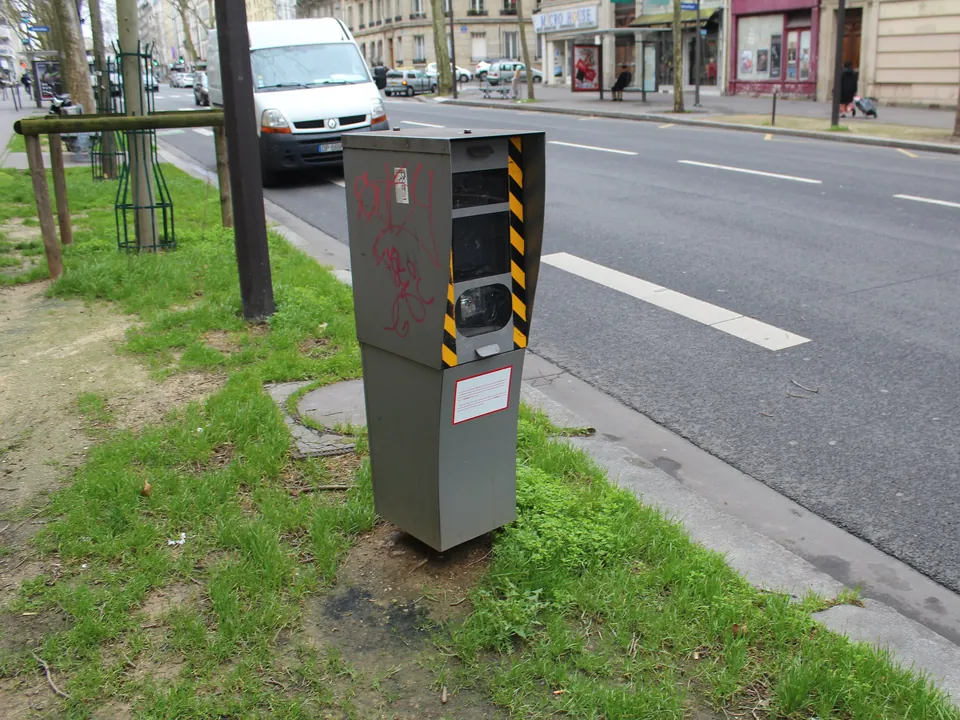
Fixed speed cameras are usually announced by signs, although the law does not require it. Red light and level crossing cameras, mobile radars and unmarked camera cars are never announced.

A grey speed camera box with yellow and black stripes on a post beside a Paris avenue
Avenue Daumesnil, ParisPhoto: Chabe01, CC BY-SA 4.0

Fixed speed camera

Signposted

Radar fixe

Catches: Speeding. It measures each vehicle's speed as it passes, from the front or the rear, in one or both directions.

The first type installed in France, placed in the most dangerous areas. Double-face versions photograph the rear, so they also catch motorbikes.

Fixed speed camera

Signposted

Radar discriminant

Catches: Speeding by vehicle category. It tells lorries, cars and motorbikes apart, identifies the lane, and checks from the front and the rear.

It can pick out the offending vehicle when several appear in one photo.

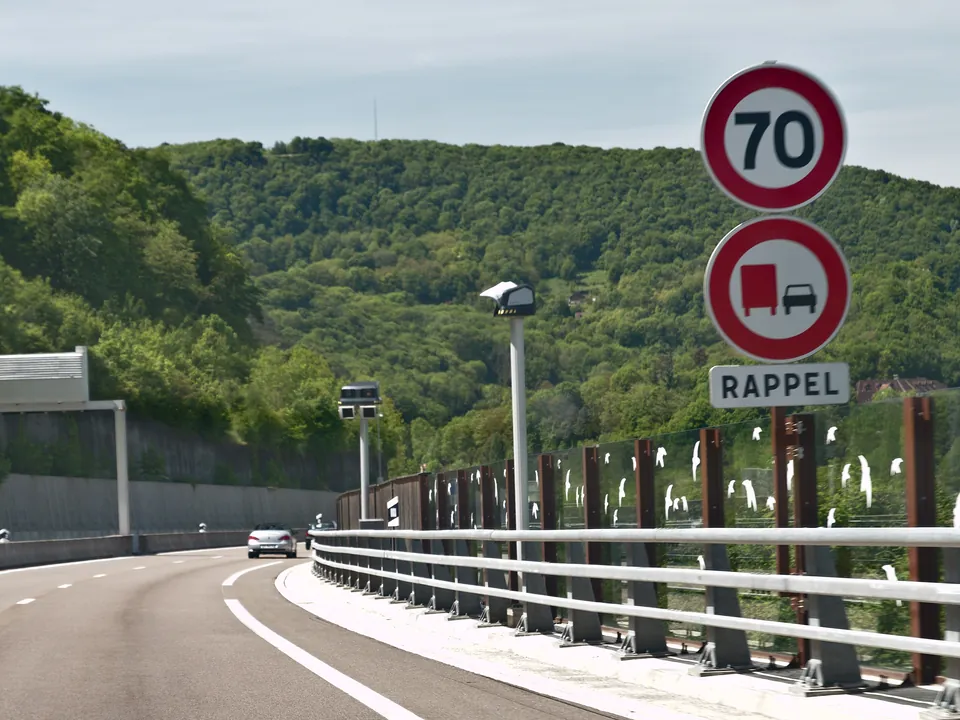
Average speed cameras on a pole beside a dual carriageway, below 70 km/h signs
RN57 approaching BesançonPhoto: Clément Eustache, CC BY-SA 4.0

Average speed camera

Signposted

Radar tronçon (radar vitesse moyenne)

Catches: Average speed over a section of road.

A camera with plate reading records each vehicle at the entry point. The offence is recorded at the exit point.

Every camera type in France, the warning signs and how fines reach you

Licence and International Driving Permits

Licence fromPermitNotes
the EU, Ireland, IcelandNot neededLicences from EU and EEA countries are recognised for as long as they are valid. The holder must be at least 18 and must respect any medical conditions on the licence.
United KingdomNot neededA UK photocard licence can be used without an IDP or translation. Holders of an old paper licence may need a photocard licence or an IDP.
Australia, New Zealand, United States, Canada, JapanRequiredThe licence must be written in French or come with an International Driving Permit or an official French translation. A translation made abroad must be legalised or apostilled. One made in France must be done by an approved translator or by the issuing country's embassy. A licence written in French needs neither.

What to carry

  • Driving licence
  • International Driving Permit or official French translation, if your licence is from outside the EU and EEA, is not in French and is not a UK licence

Zones and tolls

Crit'Air low emission zones (ZFE-m)

A Crit'Air sticker is compulsory to drive in a ZFE-m, and each zone bans older vehicles by sticker class on its own timetable. In Greater Paris, cars without a sticker or with Crit'Air 5, 4 or 3 cannot drive from Monday to Friday, 8am to 8pm, except on public holidays. Parliament voted to abolish the zones, but the Constitutional Council struck that out on 21 May 2026, so they remain in force. Where: 25 urban areas, including Greater Paris, Lyon, Grenoble, Strasbourg, Lille, Montpellier, Toulouse, Aix-Marseille, Nice, Rouen and Bordeaux. Entry is marked by a zone sign (B56). Fine: €68 fixed fine, up to €450.

Tip: Check that the hire car shows a Crit'Air sticker on the windscreen. For a foreign-registered car, order the sticker only from certificat-air.gouv.fr, the one official site.

Paris Centre limited traffic zone (ZTL)

Driving through the zone without stopping is banned 24 hours a day, 7 days a week. You may drive in if your trip starts or ends inside the zone. Where: Paris Centre, which is the 1st, 2nd, 3rd and 4th arrondissements. The Grands Boulevards on the north side, the Île de la Cité, the Île Saint-Louis and the right-bank quays in the west to east direction are outside the zone. Fine: None yet. On 28 September 2026 the city said no fines were being issued during a teaching phase.

Tip: Plan your route around the zone unless your trip starts or ends inside it.

Winter equipment zones (Loi Montagne)

From 1 November to 31 March, cars must have four winter tyres with the alpine symbol, or carry snow chains or snow socks for at least two driving wheels. Where: Designated communes in the Alps, Corsica, the Massif Central, the Jura, the Pyrenees and the Vosges, marked by entry and exit signs (B58 and B59).

Tip: Ask the hire company for winter tyres or chains if you will drive into the mountains in winter.

Tolls

Many autoroutes charge a toll. Most are paid at toll plazas, but the A79 and the Paris to Normandy A13 and A14 use free-flow tolling with no barriers.

  • On free-flow sections, cameras and sensors record your plate when you enter and leave. Signs warn you about 2.5 km before the entrance.
  • Without a toll tag, pay within 3 days of the trip on the operator's website (Aliae for the A79, Sanef for the A13 and A14) or by card or cash at a shop in the Nirio network.
  • With a hire car, pay online or at a Nirio shop using the plate number and the dates of your rental.
  • If you pay late, the toll plus €10 is due within 2 weeks of the payment notice, then the toll plus €90 up to 2 months, and after that a €375 fine.
  • The Boulay interchange on the A4 also uses free-flow tolling.
  • Scam texts and emails claim to be from Sanef and ask for urgent payment. Pay only on the operator's official website.
  • At toll plazas, signs before the booths show the payment methods accepted in each lane, including electronic tags (télépéage).
Fuel and parking

At the pumpMeans
GazoleDiesel Easy to get wrong
SP95 / SP98Unleaded petrol, labelled E5
SP95-E10Unleaded petrol, labelled E10
Superéthanol E85High-ethanol fuel, labelled E85. Check your car is compatible before using it. Easy to get wrong
GPLLPG, labelled LPG
  • A blue disc with a red border and one red bar means no parking. With a red X it means no stopping or parking.
  • Zone signs mark areas where parking is limited by time and checked with a parking disc, and areas where parking must be paid.

Seasons and weather

  • From 1 November to 31 March, cars in designated mountain communes must have winter tyres or carry snow chains or snow socks. The communes are in the Alps, Corsica, the Massif Central, the Jura, the Pyrenees and the Vosges, and each prefect lists them.
  • Signs mark where the winter equipment zone starts and ends (B58 and B59).
  • Since 1 November 2024, winter tyres must carry the alpine symbol as well as an M+S marking, and must be fitted on all four wheels.
  • Where a snow chain sign (B26) is posted, chains must be fitted on at least two driving wheels, even with winter tyres, until the end sign (B44). Not doing so can cost €135, and the car can be immobilised.

Driving in the cities

Paris

Most streets are limited to 30 km/h. Exceptions kept at 50 km/h include the Maréchaux boulevards, the Champs-Élysées and avenue Foch.

The boulevard périphérique ring road has been limited to 50 km/h since October 2024.

On weekdays from 7am to 10.30am and 4pm to 8pm, the périphérique's left lane is reserved when a white diamond is lit. It is for vehicles carrying at least two people, buses, coaches, taxis and some others. Cameras check occupancy, and the fine is €135.

Parts of the A1 and A13 into Paris have lanes for vehicles with at least two people at weekday peak times, outside school holidays.

Through traffic is banned in the 1st to 4th arrondissements (Paris Centre). No fines were being issued as of 28 September 2026.

Greater Paris is a low emission zone. Cars without a Crit'Air sticker or with Crit'Air 5, 4 or 3 cannot drive there on weekdays from 8am to 8pm.

Lyon

The Lyon metropolitan area is a low emission zone. Cars without a Crit'Air sticker or with Crit'Air 5, 4 or 3 are banned.

From 2028, Crit'Air 2 cars will also be banned in the central area.

Nice

The Nice Côte d'Azur metropolitan area is a low emission zone. Cars without a Crit'Air sticker or with Crit'Air 5 are banned.

Questions people ask about driving in France

Do I need an International Driving Permit to drive in France?

Only if your licence was issued outside the EU and EEA and is not written in French. You then need an International Driving Permit or an official French translation. UK photocard licences do not need one.

Can you turn right on a red light in France?

No. A red light means stop, unless a flashing amber arrow beside it points the way you are going.

Do I have to carry a breathalyser in France?

No. It has not been compulsory since 22 May 2020. You must carry a hi-vis vest and a warning triangle.

What is the speed limit on French autoroutes?

130 km/h, or 110 km/h in rain. Probationary drivers are limited to 110 km/h.

What is the drink-drive limit in France?

0.5 g/L of blood (0.25 mg/L of breath). It is 0.2 g/L for probationary licence holders.

Can I drive through central Paris?

Not straight through. The 1st to 4th arrondissements are a limited traffic zone, and you may only drive in if your trip starts or ends there.

How do I pay tolls on the A79, A13 and A14 with no booths?

Pay within 3 days on the operator's website (Aliae for the A79, Sanef for the A13 and A14) or at a Nirio shop, using your plate number. With a toll tag it is charged automatically.

Are speed camera apps legal in France?

Yes, if they warn of danger zones rather than exact camera positions. Radar detectors are illegal, with a fine of up to €1,500.

Driving in France soon?

Get the before-you-drive checklist for France by email, with what to carry, what to check on the hire car, and the rules people get fined for.

The checklist now, one more email a few days later, and a reminder before you drive if you add the date. Unsubscribe any time.

France for drivers from…

The same guide, with only what's different from home.

Sources

Checked 15 October 2026. Official sources first.

  1. Conduire en France avec un permis étranger pendant un court séjour ou la durée des études (F2611), verified 1 June 2026 Service Public (Direction de l'information légale et administrative)
  2. Alcool au volant (F2881), verified 27 August 2026 Service Public (Direction de l'information légale et administrative)
  3. Vitesse au volant (F19460), verified 29 December 2025 Service Public (Direction de l'information légale et administrative)
  4. France travel advice: Safety and security GOV.UK (Foreign, Commonwealth and Development Office)
  5. Radars de contrôle de la vitesse fixes Sécurité Routière (Ministère de l'Intérieur)
  6. Radar vitesse embarqué Sécurité Routière (Ministère de l'Intérieur)
  7. Voiture radar Sécurité Routière (Ministère de l'Intérieur)
  8. Sanctions suite à un flash radar Sécurité Routière (Ministère de l'Intérieur)
  9. Intersections et priorités Sécurité Routière (Ministère de l'Intérieur)
  10. Croisement et dépassement Sécurité Routière (Ministère de l'Intérieur)
  11. Conduire en France avec un permis étranger Sécurité Routière (Ministère de l'Intérieur)
  12. Vignette Crit'Air (F33371), verified 1 January 2026 Service Public (Direction de l'information légale et administrative)
  13. Les ZFE françaises Mieux respirer en ville (French government)
  14. La Zone à trafic limité en vigueur dans le centre de Paris : comment ça marche ? (updated 28 September 2026) Ville de Paris
  15. Est-il obligatoire d'avoir un éthylotest dans sa voiture ? Sécurité Routière (Ministère de l'Intérieur)
  16. Radars de franchissement Sécurité Routière (Ministère de l'Intérieur)
  17. ZFE : le Conseil constitutionnel censure la suppression des zones à faibles émissions (21 May 2026) LCP Assemblée nationale
  18. Voie réservée sur le périphérique : les verbalisations débutent le 2 mai (updated 2 May 2025) Ville de Paris
  19. Dispositifs audio au volant (R412-6-1, from 1 July 2015) DRIEAT Île-de-France (images MI/DICOM, Ministère de l'Intérieur)
  20. Le péage en flux libre (easy-read guide) Ministère de la Transition écologique
  21. Flux libre : le projet Sanef (autoroute operator)
  22. Pneumatiques et chaînes en hiver (30 October 2025) Mobilité Club France
  23. A guide to driving in France including the priority to the right rule, information on roundabouts and more (10 December 2021) The Connexion
  24. Les panneaux de radars Ornikar (driving school)
  25. Les panneaux de radars Vroomvroom (driving school)
  26. Location de voiture en vacances : qui paye l'amende en cas d'infraction ? (25 July 2024) Roole Média
  27. Détecteur de radar : amende, points et risques en 2026 (verified 16 March 2026) LegiPermis
  28. Driving in France (undated guide) France.fr (Atout France)
  29. Instruction interministérielle sur la signalisation routière, 3e partie : intersections et régimes de priorité (consolidated January 2019) Cerema (Ministère de la Transition écologique)
  30. Panneaux de signalisation (IISR catalogue, June 2022) Cerema (Ministère de la Transition écologique)
  31. Feu tricolore : comprendre et interpréter les signaux routiers (updated 7 March 2024) En Voiture Simone (driving school)
  32. Les radars automatiques en France (April 2026) Matmut
  33. Carburants : un nouvel étiquetage européen à la pompe DGCCRF (Ministère de l'Économie)
  34. La vitesse limitée à 30 km/h dans la majorité des voies parisiennes (updated 8 October 2021) Ville de Paris