Driving in Germany: the road rules for visitors

Checked 15 October 2026 against official sources

In Germany you drive on the right, with the steering wheel on the left, and roundabouts go anticlockwise. At junctions without signs or road markings, traffic from your right goes first, even from a small side street.

Watch for fixed, mobile and red light cameras, and for unmarked camera cars.

RightSide of the road
50km/h in towns
100km/h on country roads
Nonegeneral motorway limit, 130 advised
0.05blood alcohol limit
If signpostedturning right on red
Limitedearphones while driving
112emergency number

The rules that catch visitors out

The most important first.

  1. Priority to the right (rechts vor links)

    At junctions with no signs, lights or markings, traffic from the right goes first, even from a small side street and even at T-junctions. Unless a sign such as the yellow diamond gives you priority, assume traffic from the right goes first.

  2. No general speed limit on the Autobahn

    Where no limit is signposted, cars have no speed limit and 130 km/h is only advised. Traffic can come up behind you very fast, so check your mirrors early and signal before you pull out. Signposted limits, including electronic ones, are enforced.

  3. Emergency corridor (Rettungsgasse)

    As soon as traffic on the Autobahn or another road with two or more lanes each way slows to walking pace or stops, you must leave a corridor for emergency vehicles. It goes between the far left lane and the lane next to it: drivers in the left lane move left, everyone else moves right. Not doing so costs €200, a 1-month ban and 2 points.

  4. Never pass on the right

    Overtake only on the left, even if a slow car sits in the left lane. Passing on the right is allowed only when the left lane is queuing or crawling. Outside towns it costs €100 and 1 point.

  5. No stopping, turning or reversing on the Autobahn

    Stopping on the Autobahn is banned, including on the hard shoulder, except in an emergency or breakdown. Turning round and reversing are banned too, even if you miss your exit. Reversing on the carriageway costs €200, a 1-month ban and 2 points.

  6. Turning across cyclists

    When you turn, you must let cyclists going straight on through, including those on a cycle path beside the road. Check your mirror and over your shoulder before every turn.

  7. Winter tyres depend on the weather, not the date

    If the road is icy, snowy or slushy, you must have winter tyres with the Alpine symbol, whatever the date. Check that a hire car in winter has them.

10 more rules worth knowing

Roundabouts go anticlockwise

Go anticlockwise and give way to traffic already on the roundabout, which comes from your left. Traffic on the roundabout has priority only where a give way sign stands with the blue roundabout sign. A circular junction without a give way sign follows priority to the right, so traffic entering it goes first.

Camera warnings are illegal

Radar detectors and the camera-warning function of a phone app or sat nav are banned. A court has ruled that a passenger may not run such an app either. The fine is €75 and 1 point, and police can seize a radar detector. Radio traffic reports that mention cameras are allowed.

Green arrow on red

Right turns on red are banned unless a small green arrow sign is fixed beside the light. Even then you must stop completely first and give way to everyone.

Buses at stops with hazard lights on

You may pass a bus or school bus that is stopped at a stop with its hazard lights on only at walking pace. This applies to oncoming traffic too. You may not overtake a bus approaching a stop with its hazard lights on.

Traffic-calmed areas

A blue sign showing people, a child playing and a car marks a traffic-calmed area. Drive at walking pace, let pedestrians use the whole street and park only in marked bays.

Speed limits

Some stretches of motorway have no general limit. 130 km/h is the recommended maximum, and many sections are signposted lower. The sign with the town's name on it sets the town limit by itself, usually with no speed sign.

What the car must carry

The car must carry a warning triangle, a hi-vis vest, a first aid kit and winter tyres (in winter). Hire cars should have them, but check before you drive away, because the driver gets the fine.

Umweltzonen (low emission zones)

Only vehicles with a green Umweltplakette sticker on the windscreen may enter. The rule also applies to foreign-registered vehicles. Where: 35 zones as of August 2026, including Berlin, Munich, Frankfurt am Main, Cologne, Düsseldorf, Stuttgart, Bremen, Leipzig and one zone covering 13 cities of the Ruhr. Hannover, Freiburg and Mainz lifted their zones in 2024 and 2025. Fine: €100. Check that a hire car has the green sticker on the inside of the windscreen before you drive into a city. If you bring your own car, order the sticker online before you travel. It costs about €5 to €20.

Diesel driving bans

Older diesel cars are banned. Euro 4 and older diesels may not enter the Munich low emission zone or use the Mittlerer Ring, and may not enter the Stuttgart zone. In Stuttgart's small inner zone, Euro 5 diesels are banned too. Darmstadt bans Euro 5 and older diesels on Hügelstraße and Heinrichstraße. Where: Munich, Stuttgart and two streets in Darmstadt. Fine: €100 plus fees. Euro 6 diesels are not affected. Check the emission class if you are offered an older diesel.

Drink driving

The blood alcohol limit is 0.05, and zero for drivers under 21, and drivers in the 2-year probationary period of a German licence. The limit is 0.5 per mille in blood or 0.25 mg/l in breath.

Speed limits

Where no sign says otherwise, in kilometres per hour.

50
Towns and cities
Applies from the yellow town sign. Many side streets are signposted 30 km/h zones. Traffic-calmed areas, marked by a blue sign showing people, a child playing and a car, are walking pace.
100
Country roads
Cars and other vehicles up to 3.5 t on ordinary roads outside towns. Cars towing a trailer are limited to 80 km/h. Authorities can sign some roads up to 120 km/h.
130
Dual carriageways
No general limit. 130 km/h is the recommended maximum. Roads outside towns with a central barrier or divider, or with at least two marked lanes each way, have no general limit for cars. The 130 km/h advisory applies, and many sections are signposted lower. A Kraftfahrstraße (blue sign with a white car) with one lane each way and no divider keeps the 100 km/h rural limit.
130
Motorways
No general limit. 130 km/h is the recommended maximum. There is no general limit for cars on the Autobahn. Where no limit is signposted, 130 km/h is the recommended maximum. Many stretches have limits on fixed or electronic signs. Cars towing a trailer are limited to 80 km/h.
  • The yellow town sign sets the 50 km/h limit by itself. The same sign with a red line through the name, as you leave, ends it.
  • Within towns, expect 30 km/h zones away from the main priority roads.
  • A supplementary plate can restrict a speed limit to wet roads.
  • The limits are the same for new drivers.

Who goes first

Look left first

YouFrom your leftFrom your right
You stop at the stop line.
Traffic keeps to the right here, so the lane nearest you carries cars coming from your left. Look left, then right, then left again before you pull out.

Priority to the right

YouGoes first
Both cars arrive at a junction with no signs or lines.
At a junction with no signs, signals or road markings, the car coming from your right goes first, even from a small side street.

When your road has priority

YouGives way
You are on a priority road, shown by the yellow diamond.
The yellow diamond means your road has priority and side roads have a give way line. Watch for the same diamond with a black bar across it, which means priority to the right is back.

The app animates all 7 junctions for Germany, including the ones above.

Open it in the app

Signs to know

Priority roadVorfahrtstraße

You are on a priority road. Traffic from side roads must give way to you at every junction.

End of priority roadEnde der Vorfahrtstraße

Your priority ends. Priority to the right applies at the next junction without signs.

Junction ahead, priority to the rightKreuzung oder Einmündung mit Vorfahrt von rechts

At the next junction, traffic from the right has priority.

Priority at the next junctionVorfahrt

You have priority at the next junction only.

Give wayVorfahrt gewähren.

Give way to traffic on the road you are entering.

STOPStop and give wayHalt. Vorfahrt gewähren.

Stop and give way to traffic on the road you are entering.

FÜSSENTown entry signOrtstafel

You are entering a built-up area. The 50 km/h limit starts at this sign, with no speed sign needed.

FÜSSENTown exit signOrtstafel (Rückseite)

You are leaving the built-up area. The 50 km/h urban limit ends.

End of all restrictionsEnde sämtlicher streckenbezogener Geschwindigkeitsbeschränkungen und Überholverbote

All signposted speed limits and overtaking bans on this stretch end.

Autobahn (motorway)Autobahn

Autobahn rules start here.

UmweltZONELow emission zoneUmweltzone

Low emission zone. Only vehicles displaying a sticker of a colour shown on the plate may enter. All current zones admit only the green sticker.

Green arrow (right turn on red)Grünpfeil

You may turn right while the light is red, after stopping.

All 26 road signs in Germany, explained

Speed cameras

Germany uses fixed speed cameras, mobile cameras, red light cameras and unmarked police cars that film from behind. There is no official camera warning sign. Radar detectors and camera-warning apps are illegal. Section control has only been used on one stretch of the B6 near Hanover, which was reported switched off in January 2024.

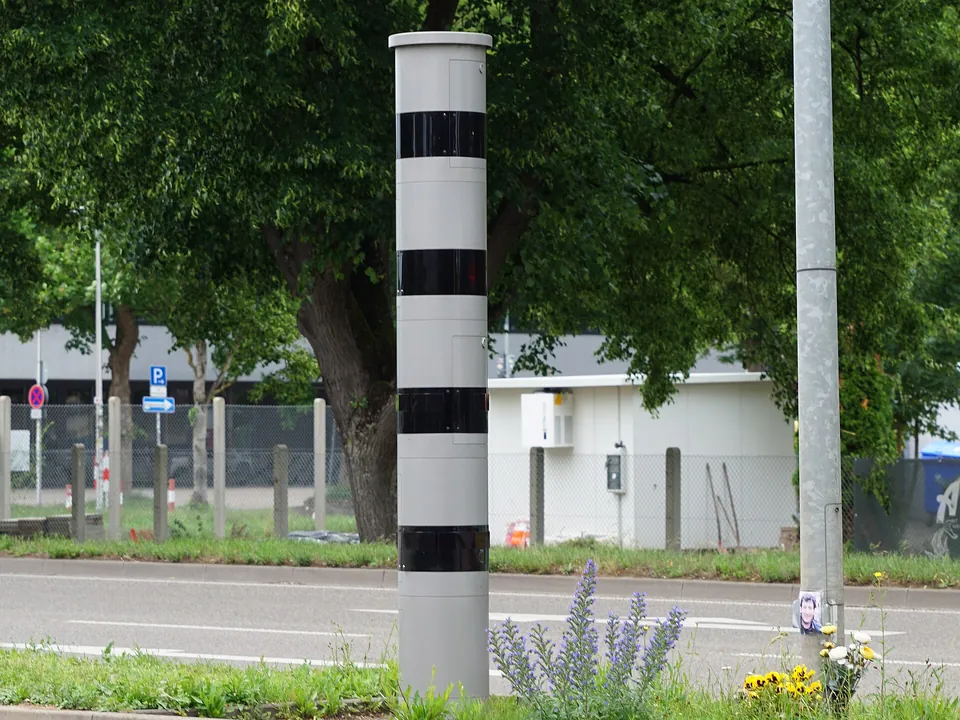
A grey speed camera column with black bands beside a town road
Europastraße, TübingenPhoto: Giftzwerg 88, CC BY-SA 4.0

Fixed speed camera

Sometimes signposted

Blitzer, Blitzersäule, Starenkasten

Looks like: Older units are a box with one or more lenses on a pole. Modern units are a grey column with three or more dark rings.

Catches: Speeding. Some also catch red light offences and tailgating.

Sometimes a sign warns of the camera, but you may see it too late.
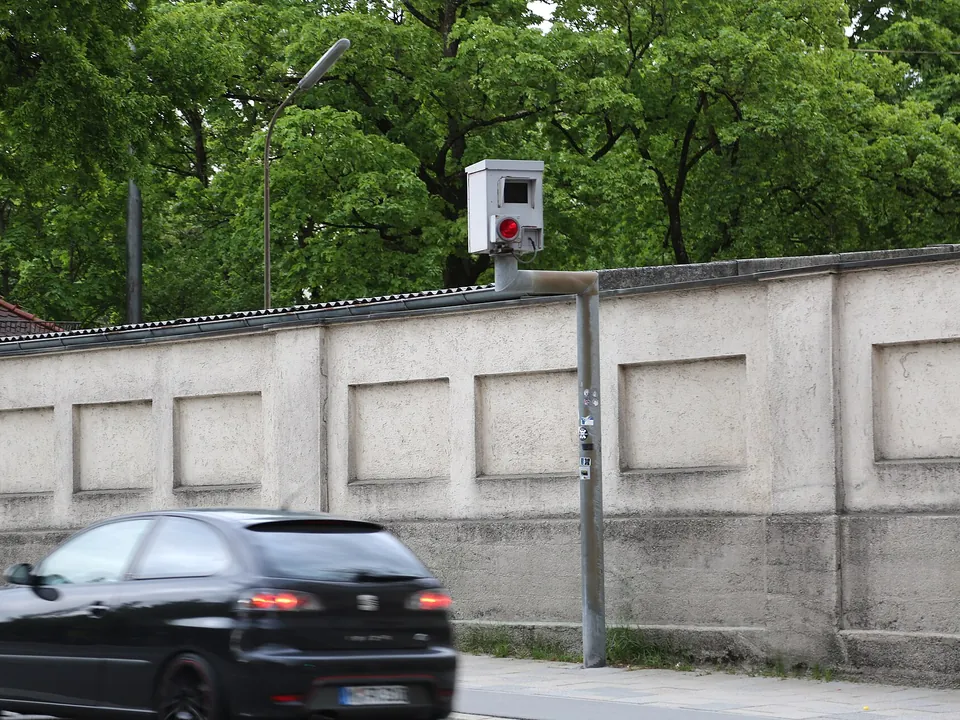
A red light camera box on a bracket above a road as a car passes
Boschetsrieder Straße, MunichPhoto: Henning Schlottmann (User:H-stt), CC BY-SA 4.0

Red light camera

No warning

Ampelblitzer, Rotlichtblitzer

Looks like: A camera box a few metres past the traffic light on the right, triggered by sensor loops set into the road surface. Some newer units give little or no visible flash.

Catches: Running a red light. Many also record speeding at the same time.

The first photo is taken at the stop line and the second as you cross the junction.

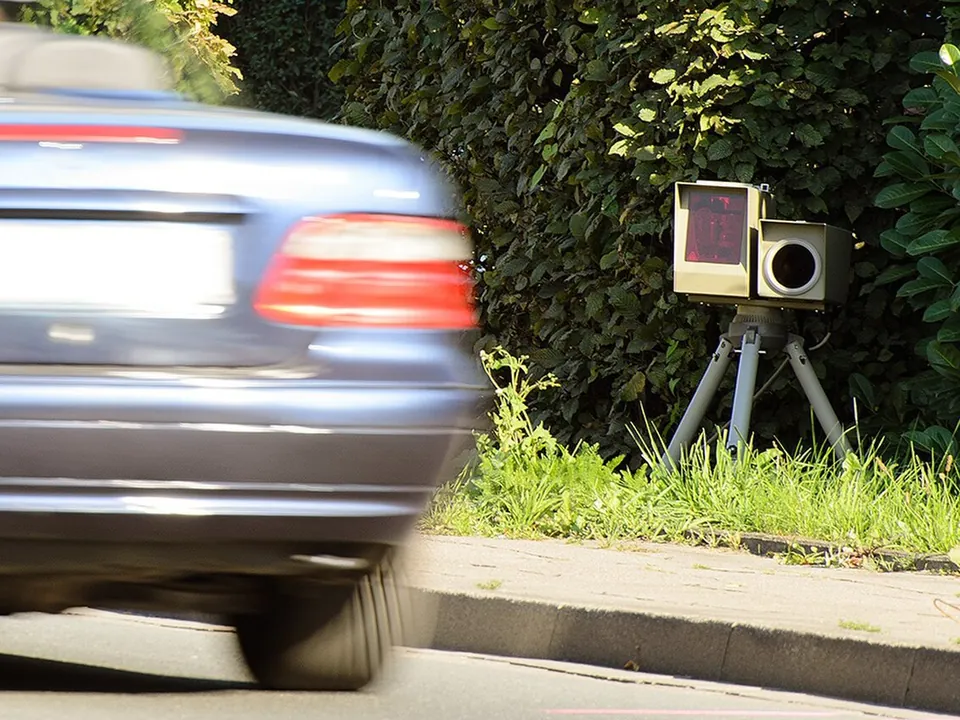
A mobile speed camera on a tripod at the kerb as a car passes
Dolberger Straße, HammPhoto: Dirk Vorderstraße, CC BY 2.0

Mobile camera

No warning

Mobiler Blitzer, Laserpistole

Looks like: A box with one or more lenses on a tripod or pole beside the road, a measuring device inside a parked car, or a police officer with a laser gun.

Catches: Speeding.

Every camera type in Germany, the warning signs and how fines reach you

Licence and International Driving Permits

Licence fromPermitNotes
the EU, Iceland, NO, LI, SwitzerlandNot neededLicences issued in the EU, the EEA and Switzerland are recognised without a translation.
United KingdomNot neededThe UK government says a UK photocard licence is enough for stays of up to 6 months. For longer stays you also need a 1968 IDP, which can only be bought in the UK.
New ZealandNot neededGermany has waived the translation requirement for New Zealand licences.
United States, Canada, Australia, JapanRequiredGerman law requires a translation of these licences. An International Driving Permit serves as the translation, and permits under the 1926, 1949 and 1968 conventions are all accepted. A translation by an automobile club of the issuing country or a sworn translator also works. Carry it with your licence, because the IDP alone is not valid.

What to carry

  • Driving licence
  • IDP or official translation, if your licence needs one
  • Hire agreement, or written permission from the owner if the car is not yours

Zones and tolls

Umweltzonen (low emission zones)

Only vehicles with a green Umweltplakette sticker on the windscreen may enter. The rule also applies to foreign-registered vehicles. Where: 35 zones as of August 2026, including Berlin, Munich, Frankfurt am Main, Cologne, Düsseldorf, Stuttgart, Bremen, Leipzig and one zone covering 13 cities of the Ruhr. Hannover, Freiburg and Mainz lifted their zones in 2024 and 2025. Fine: €100.

Tip: Check that a hire car has the green sticker on the inside of the windscreen before you drive into a city. If you bring your own car, order the sticker online before you travel. It costs about €5 to €20.

Diesel driving bans

Older diesel cars are banned. Euro 4 and older diesels may not enter the Munich low emission zone or use the Mittlerer Ring, and may not enter the Stuttgart zone. In Stuttgart's small inner zone, Euro 5 diesels are banned too. Darmstadt bans Euro 5 and older diesels on Hügelstraße and Heinrichstraße. Where: Munich, Stuttgart and two streets in Darmstadt. Fine: €100 plus fees.

Tip: Euro 6 diesels are not affected. Check the emission class if you are offered an older diesel.

Tolls

Cars pay no toll or vignette on the Autobahn or other main roads. Only two tunnels charge cars.

  • Herrentunnel in Lübeck (B 75 towards Travemünde): €2.30 per car, one way.
  • Warnowtunnel in Rostock: €4.40 per car from 1 November to 30 April and €5.40 from 1 May to 31 October. Credit cards are accepted only in the staffed lane.
  • The truck toll applies to commercial vehicles of 3.5 t and over on the Autobahn and federal roads. Motorhomes used only to carry people are exempt.

Fuel and parking

At the pumpMeans
BenzinPetrol (gasoline)
SuperUnleaded petrol with up to 5 per cent ethanol, labelled E5
Super E10Unleaded petrol with up to 10 per cent ethanol
Super PlusPremium unleaded petrol with up to 5 per cent ethanol
DieselDiesel, labelled B7 in a square
Diesel B10Diesel with more biodiesel than standard diesel, labelled B10 in a square Easy to get wrong
HVO100 (XTL)Paraffinic renewable diesel, labelled XTL in a square Easy to get wrong
Autogas (LPG)Liquefied petroleum gas
Erdgas (CNG)Compressed natural gas
TankstellePetrol station
  • Park on the right-hand side of the road in the direction of travel. In one-way streets you may also park on the left.
  • Do not park within 5 m of a junction, or within 8 m where a cycle path runs alongside the road.
  • Where a plate shows a parking disc (Parkscheibe), set the disc to the next half hour after you arrive and display it behind the windscreen.
  • At a ticket machine (Parkscheinautomat), display the ticket so it can be read from outside. Paying by phone is allowed where it is offered.
  • A blue disc with a red border and a red X means no stopping. With a single red diagonal it means no parking: you may stop for up to 3 minutes, or to let people in or out or to load.
  • No stopping and no parking signs apply only on the side of the road where they stand, up to the next junction. Temporary signs, for example for a removal van, override signs that allow parking.
  • Leaving the car, or stopping for more than 3 minutes, counts as parking.

Seasons and weather

  • Winter tyres marked with the Alpine symbol are required whenever there is black ice, packed snow, slush, ice or frost, at any time of year. There is no fixed date.
  • The Australian government notes that winter tyres are usually needed between October and Easter, but that this varies by region.
  • A blue sign showing a tyre wrapped in chains means snow chains are compulsory from that point. The limit with chains is 50 km/h.

Driving in the cities

Berlin

The low emission zone covers the city inside the S-Bahn ring. You need the green sticker.

Munich

The low emission zone covers the area inside the Mittlerer Ring ring road. You need the green sticker.

Diesel cars of Euro 4 or older are banned in the zone and on the Mittlerer Ring itself. Euro 5 and Euro 6 diesels are not affected. The fine is €100.

Frankfurt am Main

The low emission zone covers the area inside the Autobahn ring. You need the green sticker.

Stuttgart

Stuttgart has a low emission zone, with a stricter small zone covering the centre, Bad Cannstatt, Zuffenhausen and Feuerbach.

Euro 4 and older diesels are banned in the whole zone. Euro 5 diesels are also banned in the small zone.

Questions people ask about driving in Germany

Is there a speed limit on the German Autobahn?

There is no general limit for cars, but 130 km/h is the recommended maximum. Many stretches have signposted limits, and those are enforced.

Can you turn right on red in Germany?

Only where a small green arrow sign is fixed beside the red light. You must stop completely first and give way to everyone.

Do I need an International Driving Permit to drive in Germany?

Not with an EU, EEA, Swiss, UK or New Zealand licence. Drivers with licences from the US, Canada, Australia and Japan need an IDP or an official translation, carried with the licence.

What is the drink-driving limit in Germany?

0.5 per mille (0.05 per cent). Drivers under 21 and drivers in the probationary period of a German licence must not drink at all.

Are speed camera apps legal in Germany?

No. Radar detectors and the camera-warning function of apps and sat navs are banned while driving, and a court has ruled that a passenger may not run one either. The fine is €75 and 1 point.

Do I need winter tyres in Germany?

Yes, whenever the road has snow, ice, slush or frost, whatever the date. They must carry the Alpine symbol.

Does a rental car need an environmental sticker in Germany?

Yes, to enter a low emission zone (Umweltzone) it needs the green Umweltplakette on the windscreen. Driving in without one costs €100.

What is the Rettungsgasse?

The emergency corridor. When traffic on a road with two or more lanes each way slows to walking pace or stops, the left lane moves left and all other lanes move right to leave a gap for emergency vehicles.

Driving in Germany soon?

Get the before-you-drive checklist for Germany by email, with what to carry, what to check on the hire car, and the rules people get fined for.

The checklist now, one more email a few days later, and a reminder before you drive if you add the date. Unsubscribe any time.

Germany for drivers from…

The same guide, with only what's different from home.

Sources

Checked 15 October 2026. Official sources first.

  1. Straßenverkehrs-Ordnung (StVO), road traffic regulations, as amended to 30 January 2026 Federal Ministry of Justice (gesetze-im-internet.de)
  2. Bußgeldkatalog-Verordnung (BKatV), federal fines catalogue, as amended to 12 August 2026 Federal Ministry of Justice (gesetze-im-internet.de)
  3. Straßenverkehrsgesetz (StVG), road traffic act, as amended to 25 September 2026 Federal Ministry of Justice (gesetze-im-internet.de)
  4. Fahrerlaubnis-Verordnung (FeV) § 29, foreign driving licences Federal Ministry of Justice (gesetze-im-internet.de)
  5. Fahrerlaubnis-Verordnung (FeV) Anlage 13, penalty points Federal Ministry of Justice (gesetze-im-internet.de)
  6. Straßenverkehrs-Zulassungs-Ordnung (StVZO) § 53a, warning triangle and safety vest Federal Ministry of Justice (gesetze-im-internet.de)
  7. Straßenverkehrs-Zulassungs-Ordnung (StVZO) § 35h, first aid kit Federal Ministry of Justice (gesetze-im-internet.de)
  8. Straßenverkehrs-Zulassungs-Ordnung (StVZO) § 36, tyres Federal Ministry of Justice (gesetze-im-internet.de)
  9. Autobahn-Richtgeschwindigkeits-Verordnung, 130 km/h advisory speed Federal Ministry of Justice (gesetze-im-internet.de)
  10. Gültigkeit ausländischer Fahrerlaubnisse in Deutschland (2 March 2026) Federal Ministry of Transport (BMV)
  11. Germany travel advice: safety and security UK Foreign, Commonwealth and Development Office (GOV.UK)
  12. Driver's licenses fact sheet German Missions in the United States (germany.info)
  13. Germany travel advice Smartraveller, Australian Government
  14. Travel advice and advisories for Germany (11 August 2026) Government of Canada
  15. Umweltzonen in Deutschland, table of active and lifted zones (data as of 26 August 2026) Umweltbundesamt (German Environment Agency)
  16. Umweltzonen Deutschland TCS Touring Club Schweiz
  17. Fahrverbote: Wo Diesel Euro 4 und Euro 5 ausgesperrt werden (10 July 2025) ADAC
  18. German traffic rules (5 July 2024) Getting Around Germany (gettingaroundgermany.info)
  19. Abschnittskontrolle (section control) Wikipedia (German)
  20. Grüne Umweltplakette: So darf Ihr Auto in die Umweltzonen (13 October 2026) ADAC
  21. Toleranz beim Blitzer: Wie schnell ist zu schnell? (16 June 2026) ADAC
  22. Radarwarner und Blitzer-Apps: Legal oder verboten? (9 July 2026) ADAC
  23. Ampelblitzer: So sehen sie aus, diese Strafen drohen (18 June 2026) ADAC
  24. Maut in Deutschland: Wo fallen aktuell Gebühren an? ADAC
  25. Einheitliche Spritkennzeichnung in Europa (5 October 2026) ADAC
  26. Super E10 tanken (17 April 2025) ADAC
  27. Is there a minimum or maximum age for renting a vehicle with Europcar? (November 2024) Europcar Germany
  28. Rental information for Europe (last modified September 2019) SIXT
  29. Ausnahmen von den Diesel-Verkehrsverboten (Stand 21 April 2023) Landeshauptstadt Stuttgart
  30. Fahrverbot für Euro 4 Diesel in München (22 November 2024) ADAC Südbayern
  31. ADAC Bußgeldrechner inkl. Bußgeldkatalog 2026 ADAC
  32. Geschwindigkeitskontrolle (updated 30 July 2026) bussgeldkatalog.net
  33. Geschwindigkeitsmessung und Blitzer: Verfahren und Technik (updated 24 July 2026) bussgeldrechner.org
  34. HVO-Diesel und Co.: Alternative Kraftstoffe dürfen an die Tankstelle (5 May 2025) ADAC