Driving in the United States: the road rules for visitors

Checked 15 October 2026 against official sources

In the United States you drive on the right, with the steering wheel on the left, and roundabouts go anticlockwise. Many junctions have a stop sign on every approach, and cars go in the order they stopped. You can turn right on a red light after stopping, unless a sign says not to.

Watch for fixed, mobile and red light cameras.

RightSide of the road
25mph in towns
55mph on country roads
70mph on motorways
0.08blood alcohol limit
Yesturning right on red
911emergency number

The rules that catch visitors out

The most important first.

  1. Stop for school buses in both directions

    When a yellow school bus stops with its red lights flashing, traffic from both directions must stop and wait until the lights stop flashing. In New York you must stop even on the other side of a divided highway. In California you need not stop if the bus is on the other side of a divided highway or a road with two or more lanes each way. Flashing yellow lights mean the bus is about to stop.

  2. All-way stops

    At a junction where every road has a STOP sign with an ALL WAY plaque, everyone stops. Drivers then go in the order they arrived. If two arrive together, the driver on the right goes first.

  3. Right turn on red

    In most places you may turn right at a red light after stopping completely, unless a NO TURN ON RED sign is posted. Give way to pedestrians and traffic first. It is banned in New York City unless a sign allows it, and never allowed on a red arrow in California or New York.

  4. Pull over for sirens

    When an emergency vehicle approaches with a siren and flashing lights, pull over to the right edge of the road and stop until it passes. In New York this applies even when it comes towards you on a two-way road. If you are in a junction, drive through it first.

  5. Move over for stopped vehicles

    When police, emergency vehicles, tow trucks or road crews are stopped with flashing lights, move out of the lane next to them. If you can't move over, slow down. In Florida that means 20 mph below the limit.

12 more rules worth knowing

Roundabouts go anticlockwise

Go anticlockwise and give way to traffic already on the roundabout, which comes from your left.

Left turns on a green light

A green light without a green arrow lets you turn left, but you must give way to oncoming traffic and pedestrians. A flashing yellow arrow means the same. Only a green arrow gives you a protected turn.

Overtaking on both sides

On roads with two or more lanes in each direction, passing on the right is legal. Check both mirrors before changing lanes, because cars may pass on either side.

Unmarked crosswalks

Pedestrians have priority in crosswalks, including ones with no painted lines. Never pass a car that has stopped at a crosswalk.

Carpool lanes

Lanes marked with a white diamond are for vehicles carrying at least the number of people shown on the signs, such as 2+ or 3+, often only at certain hours. Double solid white lines beside them must not be crossed.

Police traffic stops

If police signal you to stop, signal right and pull onto the right shoulder. Stay in the car, turn off the radio, lower the window and keep your hands where the officer can see them. You must show your licence, proof of insurance and registration.

Passing on the right is legal

On multi-lane roads, cars can pass on either side, so check both mirrors before you change lanes.

What the car must carry

The car must carry a child car seat. Hire cars should have them, but check before you drive away, because the driver gets the fine.

Congestion Relief Zone

A car entering the zone pays once a day. With E-ZPass it is US$9 at peak times (5 am to 9 pm on weekdays, 9 am to 9 pm at weekends) and US$2.25 overnight. Without E-ZPass, the Tolls by Mail rate is US$13.50 peak and US$3.30 overnight. Rates are due to rise in 2028 and 2031. Where: Manhattan, New York City: local streets and avenues at or below 60th Street. FDR Drive, the West Side Highway (Route 9A) and the Hugh L. Carey Tunnel connections to West Street are not included. There are no booths. Most entry points only read number plates, and the bill goes to the registered owner. Hertz, Dollar and Thrifty charge hire cars once per 24-hour period and bill it separately from their toll plan.

Toll roads

Many toll roads, bridges and express lanes are cashless. Tolls are read from a windscreen tag or a photo of the number plate, and for a hire car the bill goes to the hire company, which charges you with fees. The main toll tags are E-ZPass in the north-east and midwest, SunPass and E-PASS in Florida, and FasTrak in California. E-ZPass is accepted in Delaware, Illinois, Indiana, Kentucky, Maine, Maryland, Massachusetts, Minnesota, New Hampshire, New Jersey, New York, Ohio, Pennsylvania, Rhode Island, Virginia and West Virginia, among others. Purple marks lanes and signs for cars with a registered toll account only. A purple sign showing the tag's logo and the word ONLY, sometimes with a white NO CASH plaque, means every vehicle on that road needs a registered toll account.

Centre left-turn lanes

A lane in the middle of the road, marked with a solid line and a broken line on each side, is shared by both directions for turning left. Use it only to turn, and drive no more than 200 feet (60 m) in it in California.

Drink driving

The blood alcohol limit is 0.08, and 0.02 for drivers under 21. Every state bans drivers under 21 from driving with any detectable alcohol. Most states set this at 0.02, and some lower. California sets 0.01. It is illegal in every state to drive with a blood alcohol concentration of 0.08 or more, except in Utah, where the limit is 0.05.

Speed limits

Where no sign says otherwise, in miles per hour.

SPEEDLIMIT25
Towns and cities
California sets 25 mph in business and residential districts unless a sign says otherwise. New York City is 25 mph unless another limit is posted. Other states and cities set their own town limits, so look for the signs.
SPEEDLIMIT55
Country roads
The most common maximum for roads that are not limited-access highways is 55 mph, in 21 states including New York, New Jersey and Pennsylvania. In New York, 55 mph applies wherever no limit is posted. The maximum is 65 mph in 17 states, including California and Florida, but California limits two-lane undivided highways to 55 mph unless posted. Idaho, Nevada, Oklahoma, South Dakota and Wyoming allow 70 mph, Montana allows 70 by day, and Texas allows 75.
SPEEDLIMIT70
Dual carriageways
Limited-access highways that are not interstates, such as state freeways, expressways and turnpikes. The maximum is 70 mph in 19 states and 65 mph in 17 states. Arkansas, Kansas, Maine, Missouri, Texas and Utah allow 75 mph. Florida's Turnpike is typically 70 mph.
SPEEDLIMIT70
Motorways
Interstates and other freeways are always signposted. The maximum on rural interstates is 70 mph in 20 states, 75 mph in 14 states and 65 mph in 11 states, including New York, New Jersey and Massachusetts. Montana, Nevada, North Dakota and South Dakota allow 80 mph. Hawaii's maximum is 60 mph. Some segments in Idaho, Oklahoma, Texas, Utah and Wyoming are signposted 80 mph. State Highway 130 in Texas is signposted 85 mph, the highest limit in the country. The maximum on urban interstates is 55 to 65 mph in 27 states and 70 mph or more in the other 23.
  • Speed limits are in miles per hour, and the sign doesn't say mph. 25 mph is about 40 km/h, 55 mph about 89 km/h, 65 mph about 105 km/h and 75 mph about 121 km/h.
  • You may never drive faster than is safe for the conditions, even below the posted limit. California calls this the Basic Speed Law.
  • Some school zones are as low as 15 mph. A SCHOOL SPEED LIMIT sign may apply only WHEN FLASHING or WHEN CHILDREN ARE PRESENT, or at the times shown.
  • Some states set lower limits for trucks and for cars towing trailers. California limits both to 55 mph.
  • Some highways have a minimum speed, shown on a white MINIMUM sign.
  • In California, fines double in highway work zones when workers are present. Other states post FINES DOUBLE or FINES HIGHER plaques where higher fines apply.
  • In California, if heavy rain or snow means you can't see farther than 100 feet (about 30 metres), it isn't safe to drive faster than 30 mph.

Who goes first

Look left first

YouFrom your leftFrom your right
You stop at the stop line.
Traffic keeps to the right here, so the lane nearest you carries cars coming from your left. Look left, then right, then left again before you pull out.

First to stop goes first

Stopped firstYouSame time as you
Every approach has a stop sign.
At an all-way stop everyone stops, and cars go in the order they stopped. If two stop at the same time, the car on the right goes first.

Roundabouts go anticlockwise

YouAlready on it
You arrive at the give way line.
Go anticlockwise, keeping the island on your left. Give way to cars already on the roundabout, which come from your left.

The app animates all 7 junctions for the United States, including the ones above.

Open it in the app

Signs to know

STOPStopSTOP

Stop completely before the stop line, crosswalk or junction.

ALL WAYAll-way stopALL WAY

Every road at this junction has a STOP sign.

YIELDGive wayYIELD

Give way to traffic and pedestrians.

SPEEDLIMIT30Speed limitSPEED LIMIT

Maximum speed in miles per hour.

DO NOTENTERNo entryDO NOT ENTER

No entry for vehicles from this direction.

WRONG WAYWrong wayWRONG WAY

You are driving against the traffic.

ONE WAYOne-way streetONE WAY

Traffic on this street moves only in the direction of the arrow.

NOTURN ONREDNo turn on redNO TURN ON RED

You may not turn while the light is red.

School zoneSchool

School area or school crossing.

SPEEDLIMIT20School speed limitSCHOOL SPEED LIMIT

A lower speed limit in a school zone, during the times shown.

SCHOOL BUSSTOP AHEADSchool bus stop ahead

A school bus may be stopped ahead where you can't see it.

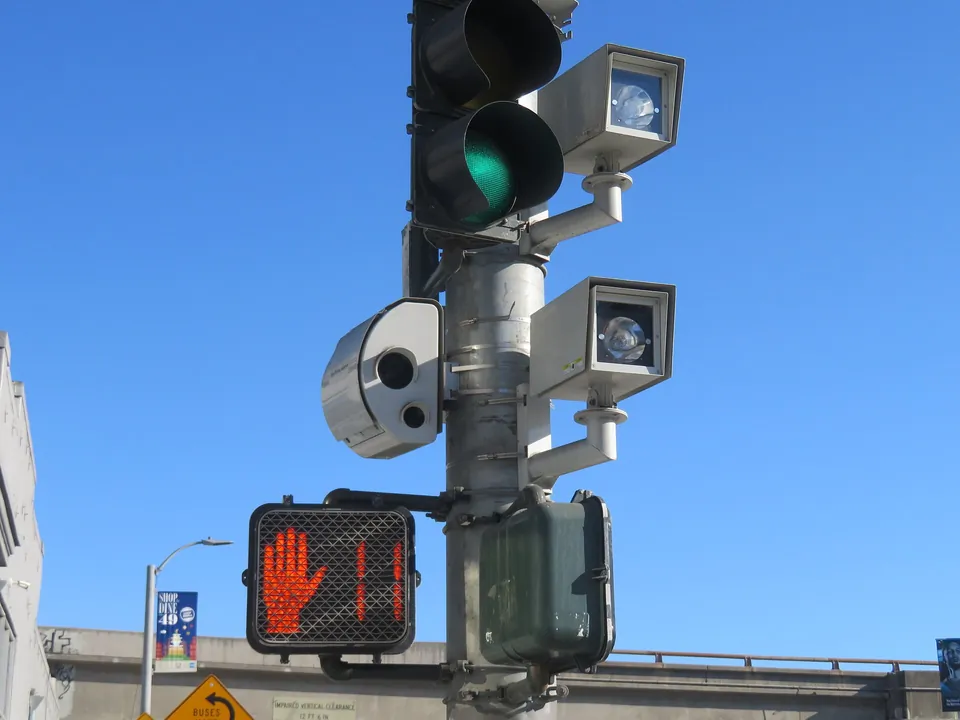
PHOTO ENFORCEDRed light cameraPHOTO ENFORCED

A camera at the traffic lights ahead photographs cars that run the red light.

All 28 road signs in the United States, explained

Speed cameras

Red light cameras and speed cameras are legal in some states and banned in others. Speed cameras are mostly found in school zones and work zones. A PHOTO ENFORCED sign is common but not always present, and the ticket goes to the car's registered owner.

Red light cameras on a traffic signal pole
4th Street and Harrison Street, San FranciscoPhoto: Pi.1415926535, CC BY-SA 4.0

Red light camera

Sometimes signposted

Red light camera (red light safety camera)

Looks like: A camera at the junction, linked to the traffic lights and to sensors just before the stop line or crosswalk.

Catches: Entering the junction after the light has turned red. A right turn on red without a full stop, or where it is banned, may also count.

Used by 351 communities in 2025, in 22 states and Washington DC. Cities with them include Chicago, Denver, New Orleans, New York City, Philadelphia, San Francisco, Seattle and Washington DC. Banned in Idaho, Maine, Mississippi, Montana, New Hampshire, South Carolina, South Dakota, Texas and West Virginia, though some Texas cities still run cameras under contracts signed before the 2019 ban. Many programmes allow up to half a second after the light turns red.

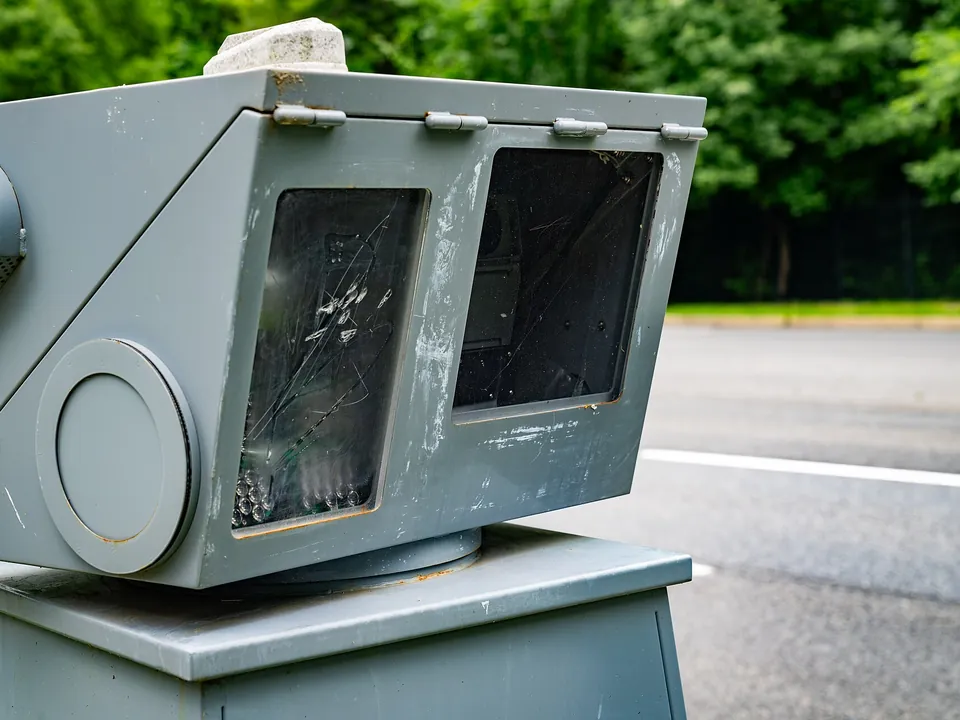
A grey speed camera housing at the side of a road
Wisconsin Avenue, Bethesda, MarylandPhoto: Tony Webster, CC BY 2.0

Fixed speed camera

Sometimes signposted

Speed camera (speed safety camera)

Looks like: A fixed camera at the roadside that measures speed by radar or by sensors in the road surface.

Catches: Speeding, usually at one spot.

Used by 338 communities in 2025, in 26 states and Washington DC, often only in school zones. New York City has speed cameras in more than 700 school zones. Banned in Idaho, Maine, Mississippi, New Hampshire, New Jersey, South Carolina, Texas, West Virginia and Wisconsin.

Mobile camera

Sometimes signposted

Mobile speed camera

Looks like: A camera placed at the roadside in a marked or unmarked police car, in a container or on a pole, measuring speed by radar or laser.

Catches: Speeding.

Some communities require an operator to be present.

Every camera type in the United States, the warning signs and how fines reach you

Zones and tolls

Congestion Relief Zone

A car entering the zone pays once a day. With E-ZPass it is US$9 at peak times (5 am to 9 pm on weekdays, 9 am to 9 pm at weekends) and US$2.25 overnight. Without E-ZPass, the Tolls by Mail rate is US$13.50 peak and US$3.30 overnight. Rates are due to rise in 2028 and 2031. Where: Manhattan, New York City: local streets and avenues at or below 60th Street. FDR Drive, the West Side Highway (Route 9A) and the Hugh L. Carey Tunnel connections to West Street are not included.

Tip: There are no booths. Most entry points only read number plates, and the bill goes to the registered owner. Hertz, Dollar and Thrifty charge hire cars once per 24-hour period and bill it separately from their toll plan.

Tolls

Many toll roads, bridges and express lanes are cashless. Tolls are read from a windscreen tag or a photo of the number plate, and for a hire car the bill goes to the hire company, which charges you with fees.

  • The main toll tags are E-ZPass in the north-east and midwest, SunPass and E-PASS in Florida, and FasTrak in California. E-ZPass is accepted in Delaware, Illinois, Indiana, Kentucky, Maine, Maryland, Massachusetts, Minnesota, New Hampshire, New Jersey, New York, Ohio, Pennsylvania, Rhode Island, Virginia and West Virginia, among others.
  • Purple marks lanes and signs for cars with a registered toll account only. A purple sign showing the tag's logo and the word ONLY, sometimes with a white NO CASH plaque, means every vehicle on that road needs a registered toll account.
  • In Florida, if you have no tag and cash isn't taken, the car's registered owner gets a Toll Enforcement Invoice with a US$2.50 admin charge. For a hire car, that is the hire company.
  • Some Florida toll booths on ramps are unstaffed and need exact change, especially after 7 pm and at weekends. The speed limit through toll booths and SunPass-only lanes is 25 mph.
  • Express lanes (managed lanes) run beside the normal lanes and charge a toll that is shown on overhead signs before the entrance. In the San Francisco Bay Area they need a FasTrak tag.
  • San Francisco Bay Area bridges take no cash. You can set up a Short-Term License Plate Account online for a hire car. It covers crossings made up to 48 hours before you set it up and trips up to 30 days ahead, but not express lanes.
  • Southern California toll roads 73, 133, 241 and 261 have no booths. Pay the toll authority within 5 days, or Hertz, Dollar and Thrifty bill you through PlatePass.
  • Hire company toll programmes include PlatePass (Hertz, Dollar, Thrifty), e-Toll, TollPass and Pass24. They charge a service fee on top of the tolls.
  • With PlatePass, if you don't opt in but use a cashless toll, you pay an admin fee for each calendar day you use a toll, plus each toll at the highest undiscounted rate. The charges reach your card 1 to 3 weeks after the rental ends.
  • If the hire car has a toll tag in a shield box on the windscreen, keep the box closed unless you have opted in to the hire company's toll plan.
  • During hurricane evacuations, Florida may suspend tolls on some roads.

Fuel and parking

At the pumpMeans
GasPetrol
Gas stationPetrol station
  • Kerb colours in California: red means no stopping or parking, yellow is for loading, white is for picking up or dropping off passengers, green is time-limited parking, and blue is for disabled permit holders.
  • Don't park within 15 feet (4.5 m) of a fire hydrant. This applies in California and New York.
  • In California, don't park within 20 feet (6 m) of a crosswalk, on the wrong side of the street, or double parked.
  • In New York, NO PARKING allows a brief stop to load goods or passengers, NO STANDING allows only picking up or dropping off passengers, and NO STOPPING allows no stop at all.
  • Parking signs with red lettering on white show a restriction. Signs with green lettering on white show where and when you may park.
  • Parking downhill against a kerb, turn the front wheels into the kerb. Parking uphill, turn them away from the kerb and let the car roll back gently against it. With no kerb, turn the wheels to the right.

Seasons and weather

  • In snowy areas, California advises carrying snow chains that fit your car.
  • On packed snow, halve your speed. On ice, drive no faster than 5 mph (California).
  • Bridges and overpasses freeze before the rest of the road.
  • In Florida, tolls may be suspended during hurricane evacuations. Carry some cash anyway, because suspension on one road doesn't mean every road.

Driving in the cities

New York City

Turning right on red is banned unless a sign allows it.

The speed limit is 25 mph unless another limit is posted.

Driving into Manhattan at or below 60th Street costs a daily congestion toll, charged by camera to the hire company and passed on to you.

Speed cameras cover more than 700 school zones, and red light cameras are in use. A red light camera ticket is up to US$50.

U-turns are illegal in business districts.

Short-term hire cars can't be added to an E-ZPass New York account.

Los Angeles

Freeway carpool (HOV) lanes are marked with a white diamond. Enter and leave only where the double solid white lines become broken.

Motorcycles may legally ride between lanes of traffic. Check mirrors before changing lanes.

Southern California toll roads 73, 133, 241 and 261 have no booths. Pay within 5 days or the hire company bills you.

Kerb colours set the parking rules: red, yellow, white, green and blue.

San Francisco

Bay Area bridges take no cash. Set up a Short-Term License Plate Account online, or the hire company bills you through its toll plan.

Bay Area Express Lanes need a FasTrak tag. Without one, you pay the toll plus penalties, and the notice goes to the address the hire company holds for you.

San Francisco uses red light cameras.

On hills, turn the wheels into the kerb facing downhill and away from it facing uphill.

Orlando

Florida toll roads take SunPass and E-PASS, which work together. Without a tag, the hire company receives a toll invoice and charges you.

Some ramp toll booths are unstaffed and need exact change, especially after 7 pm and at weekends. Slow to 25 mph through toll booths.

Hand-held phone use is banned only in school and work zones in Florida, but texting while driving is banned everywhere.

Under Florida's Move Over Law, slow to 20 mph below the limit if you can't change lanes away from a stopped emergency vehicle.
Questions people ask about driving in the United States

Can you turn right on a red light in the United States?

Yes, in most places, after stopping completely and giving way to pedestrians and traffic, unless a NO TURN ON RED sign is posted. It is banned in New York City unless a sign allows it, and you may never turn on a red arrow in California or New York.

Who goes first at a four-way stop?

The driver who stopped first. If two stop at the same time, the driver on the right goes first. Drivers turning left give way to oncoming traffic going straight.

Do you have to stop for a school bus on the other side of the road?

Usually yes. When a school bus shows flashing red lights, traffic in both directions must stop. In New York you must stop even across a divided highway. California lets you continue if the bus is on the other side of a divided highway or a road with two or more lanes each way.

What is the drink-driving limit in the United States?

0.08 per cent blood alcohol in every state except Utah, where it is 0.05. Drivers under 21 may not drive with any detectable alcohol, set at 0.02 in most states and 0.01 in California.

Can you use your phone while driving in the US?

Hands-free only in most states. Holding a phone to talk is banned in 32 states and Washington DC, including California, New York and Nevada. Texting while driving is banned in every state except Montana.

Are there speed cameras in the US?

Yes, in 338 communities in 26 states and Washington DC in 2025, mostly in school zones and work zones. Nine states ban them, including Texas and New Jersey. Red light cameras are more widespread.

How do you pay tolls in a hire car?

Most hire companies enrol you in a toll programme that bills tolls plus a daily fee. To avoid the fees, pay the toll authority directly where allowed, such as a Bay Area Short-Term License Plate Account, or use your own compatible toll tag.

What is the speed limit on US interstates?

It depends on the state. Rural interstates are most often 70 mph, with 65 mph in states such as New York and 75 or 80 mph in much of the West. The highest is 85 mph on State Highway 130 in Texas.

Driving in the United States soon?

Get the before-you-drive checklist for the United States by email, with what to carry, what to check on the hire car, and the rules people get fined for.

The checklist now, one more email a few days later, and a reminder before you drive if you add the date. Unsubscribe any time.

The United States for drivers from…

The same guide, with only what's different from home.

Sources

Checked 15 October 2026. Official sources first.

  1. Speed limit laws (maximum posted speed limits by state, October 2026) Insurance Institute for Highway Safety (IIHS)
  2. Safety camera laws (October 2026) Insurance Institute for Highway Safety (IIHS)
  3. Electronic device laws (October 2026) Insurance Institute for Highway Safety (IIHS)
  4. Alcohol and drugs Insurance Institute for Highway Safety (IIHS)
  5. Distracted Driving: state laws Governors Highway Safety Association (GHSA)
  6. Manual on Uniform Traffic Control Devices (MUTCD), 11th Edition with Revision 1, December 2025 Federal Highway Administration, US Department of Transportation
  7. California Driver's Handbook, Section 7: Laws and Rules of the Road California Department of Motor Vehicles
  8. California Driver's Handbook, Section 7: Laws and Rules of the Road (continued): sharing the road, school buses, speed limits California Department of Motor Vehicles
  9. California Driver's Handbook, Section 6: Navigating the Roads California Department of Motor Vehicles
  10. California Driver's Handbook, Section 6: Navigating the Roads (continued): parking and law enforcement stops California Department of Motor Vehicles
  11. California Driver's Handbook, Section 8: Safe Driving California Department of Motor Vehicles
  12. California Driver's Handbook, Section 8: Safe Driving (continued): seat belts and child seats California Department of Motor Vehicles
  13. California Driver's Handbook, Section 8: Safe Driving (continued): speed, emergencies and phones California Department of Motor Vehicles
  14. California Driver's Handbook, Section 9: Alcohol and Drugs California Department of Motor Vehicles
  15. New York State Driver's Manual New York State Department of Motor Vehicles
  16. Visiting Florida Frequently Asked Questions Florida Department of Highway Safety and Motor Vehicles
  17. Frequently Asked Questions Florida's Turnpike Enterprise (Florida Department of Transportation)
  18. Rental Vehicles Bay Area FasTrak
  19. PlatePass FAQ PlatePass (Verra Mobility), toll service for Hertz, Dollar and Thrifty
  20. Congestion Relief Zone FAQ Metropolitan Transportation Authority (MTA)
  21. Congestion Relief Zone toll rate schedule Metropolitan Transportation Authority (MTA)
  22. Congestion Relief Zone Metropolitan Transportation Authority (MTA)
  23. Drunk Driving National Highway Traffic Safety Administration (NHTSA)
  24. Red light running (how red light safety cameras work, communities using them) Insurance Institute for Highway Safety (IIHS)
  25. Speed (speed safety cameras: how they work and where they are used) Insurance Institute for Highway Safety (IIHS)