Driving in the United Kingdom: the road rules for visitors

Checked 15 October 2026 against official sources

In the United Kingdom you drive on the left, with the steering wheel on the right, and roundabouts go clockwise.

Watch for fixed, mobile, average speed and red light cameras.

LeftSide of the road
30mph in towns
60mph on country roads
70mph on motorways
0.08blood alcohol limit
Noturning left on red
999emergency number

The rules that catch visitors out

The most important first.

  1. Drive on the left, and go clockwise round roundabouts

    Traffic keeps to the left. At roundabouts you give priority to traffic coming from your right, and go round clockwise. Look right first when you join.

  2. The national speed limit sign is not a derestriction sign

    A white disc with a black diagonal band means the national speed limit applies. For a car that is 60 mph on a single carriageway and 70 mph on a dual carriageway or motorway.

  3. Street lights usually mean 30 mph, or 20 mph in Wales

    On roads with street lights, a 30 mph limit usually applies unless signs show otherwise. In Wales the default on these roads has been 20 mph since September 2023, and there are no repeater signs.

  4. No turning on a red light

    You must not cross the stop line while the light is red. There is no left turn on red. Only a green filter arrow lets you go.

  5. Don't hold your phone, even in a queue

    Holding a phone or sat nav while driving is illegal even when you are stopped at lights or in traffic. The penalty is £200 and 6 penalty points.

  6. Smart motorways: obey the red X and the red circle

    A red X above a lane means the lane is closed, and driving in it is a £100 offence with 3 points, caught by cameras. A speed limit shown in a red circle on an overhead sign is the legal limit.

  7. Scotland's drink-drive limit is lower

    The limit in Scotland is 50 mg of alcohol per 100 ml of blood, against 80 mg in England, Wales and Northern Ireland. The safest choice is not to drink at all before driving.

10 more rules worth knowing

Yellow box junctions

Criss-cross yellow lines mark a box junction. You must not enter the box until your exit road or lane is clear. You may wait in it to turn right if only oncoming traffic or other right-turning vehicles stop you. In London, a penalty for this is £160.

Bus lanes have hours

Don't drive in a bus lane during its hours of operation, shown on the signs. You may enter one to stop, load or unload where this is not prohibited. In London, a bus lane penalty is £160.

London charges you must pay yourself

Central London has a Congestion Charge of £18 a day, from 7am to 6pm on weekdays and 12pm to 6pm at weekends and on bank holidays. All of Greater London is an Ultra Low Emission Zone. Hire car drivers must pay these themselves online, or face a £180 penalty plus a hire company fee.

The Dartford Crossing is paid online

The M25 crossing east of London costs £3.50 for a car between 6am and 10pm. Pay online, by phone or at a Payzone shop by midnight the day after you cross, or you get a £70 penalty.

Give way to pedestrians at side roads

When turning into or out of a side road, give way to pedestrians crossing or waiting to cross it. At a zebra crossing you must give way once a pedestrian has stepped onto it.

Congestion Charge

Charging hours are 7am to 6pm Monday to Friday, and 12pm to 6pm on Saturdays, Sundays and bank holidays. TfL suspended the charge from 25 December 2025 to 1 January 2026. Driving in the zone during charging hours costs £18 a day if paid in advance or on the day, or £21 if paid by midnight on the third day after travel. Electric cars get 25 per cent off only when registered for Auto Pay. Where: Central London. Fine: £180, reduced to £90 if paid within 14 days. It rises to £270 if not paid or challenged within 28 days. When you hire a car, paying the charge is your job. If the hire company has to deal with a penalty for you, it adds a fee. Budget charges £25 plus VAT.

Ultra Low Emission Zone (ULEZ)

Petrol cars must meet Euro 4 and diesel cars Euro 6, or pay £12.50 a day. The zone runs 24 hours a day, every day except Christmas Day. Where: All London boroughs, up to but not including the M25. Fine: £180, reduced to £90 if paid within 14 days. Vehicles registered outside the UK must be registered with TfL's partner EPC plc, even if they meet the standards.

Clean Air Zones

Only Birmingham and Bristol charge private cars. Cars that meet Euro 4 (petrol) or Euro 6 (diesel) don't pay. Other cars pay £8 a day in Birmingham, inside the A4540 Middleway ring road, and £9 a day in Bristol, where the charge runs midnight to midnight every day. Where: Bath, Birmingham, Bradford, Bristol, Portsmouth, Sheffield and Tyneside (Newcastle and Gateshead). Fine: £120 plus the daily charge in Bristol, reduced to £60 plus the charge if paid within 14 days. Birmingham's penalty is also £120. Pay on GOV.UK up to 6 days before you travel or by 11:59pm on the sixth day after you drive in.

Low Emission Zones (Scotland)

Petrol cars must meet Euro 4 and diesel cars Euro 6. Vehicles that don't meet the standard can't pay to enter. Cameras check every vehicle 24 hours a day, including public holidays, and the registered keeper of a vehicle that doesn't meet the standard gets a penalty charge notice. Where: City centres of Aberdeen, Dundee, Edinburgh and Glasgow. Fine: £60 for a car, reduced to £30 if paid within 14 days. It doubles with each further breach, up to £480, and goes back to £60 after 90 days without a breach. You can't register or pay in advance. The online vehicle checker can't check vehicles registered outside the UK.

Toll roads

The Dartford Crossing on the M25 east of London charges cars £3.50 between 6am and 10pm, paid online, by phone or with cash at a Payzone shop by midnight the day after you cross. Two tunnels in east London also charge. The M6 Toll near Birmingham has barriers where you pay by contactless card. Dartford Crossing: crossings between 10pm and 6am are free. Dartford Crossing: the charge applies at weekends and on bank holidays too.

Speed limits

Where no sign says otherwise, in miles per hour.

30
Towns and cities
Usually applies on roads with street lights unless signs show otherwise. In Wales the default on these roads is 20 mph.
60
Country roads
The national speed limit on single carriageways for cars and motorcycles. It is 50 mph when towing a caravan or trailer.
70
Dual carriageways
The national speed limit on dual carriageways. It is 60 mph when towing a caravan or trailer.
70
Motorways
It is 60 mph when towing a caravan or trailer. You must not exceed a limit shown in a red circle on a sign, including on overhead signs.
  • The national speed limit sign is a white disc with a black diagonal band. For cars it means 60 mph on single carriageways and 70 mph on dual carriageways and motorways. It does not mean there is no limit.
  • Speed limit signs show the number in a red ring without a unit. All limits are in miles per hour.
  • Speed limit signs, not town name signs, mark where a limit changes.
  • Wales made 20 mph the default on restricted roads in September 2023. These are usually residential streets with street lights, which had been 30 mph.
  • In Wales there are no 20 mph repeater signs, because 20 mph is the default. Councils can keep or return some roads to 30 mph, and these are signposted.
  • Most vans, and motorhomes over 3.05 tonnes unladen, have lower limits than cars on single and dual carriageways.
  • Scotland consulted on cutting the single carriageway national limit to 50 mph. In December 2025 ministers decided to keep 60 mph.
  • Northern Ireland uses the same limits as England and Scotland for cars: 30 mph in built-up areas, 60 mph outside them, and up to 70 mph on dual carriageways and motorways. 20 mph limits are increasingly common in its towns.
  • Northern Ireland: learners and newly qualified R plate drivers were limited to 45 mph. Graduated driver licensing, which started on 1 October 2026, removes that restriction.
  • Drivers crossing from Northern Ireland into the Republic of Ireland switch from mph to km/h.

Who goes first

Look right first

YouFrom your rightFrom your left
You stop at the stop line.
Traffic keeps to the left here, so the lane nearest you carries cars coming from your right. Look right, then left, then right again before you pull out.

Roundabouts go clockwise

YouAlready on it
You arrive at the give way line.
Go clockwise, keeping the island on your right. Give way to cars already on the roundabout, which come from your right.

Right is the long turn

YouOncoming
You want to turn right, and a car is coming the other way.
A right turn crosses oncoming traffic. Give way to oncoming cars, then finish the turn on the left-hand side of the road. Most mistakes happen pulling out of a car park or a quiet junction, when habit takes you to the wrong side.

The app animates all 5 junctions for the United Kingdom, including the ones above.

Open it in the app

Signs to know

National speed limitNational speed limit applies

The national speed limit applies: for cars, 60 mph on a single carriageway and 70 mph on a dual carriageway or motorway.

40Speed limitMaximum speed

The maximum speed in miles per hour until another speed limit sign.

Speed camera

Cameras enforce speed limits or other traffic rules on this road.

Variable speed limit with camera enforcementVariable speed limit

Speed limits on this road change and are shown on electronic signs. Cameras enforce them.

AVERAGE SPEEDAverage speed camerasAverage speed check

Average speed cameras measure your speed between two or more points.

GIVEWAYYieldGive way

Give way to traffic on the major road.

STOPStop

Stop and give way.

No entry

No entry for vehicles.

Mini-roundabout

Mini-roundabout ahead. Give way to vehicles from the immediate right.

BOX JUNCTIONYellow box junction (road marking)Box junction

You must not enter the box until your exit road or lane is clear.

RED XLane closedRed X

The lane is closed.

CCENTRAL ZONECongestion charge zone entranceCongestion charging zone

You are entering the London Congestion Charge zone.

All 29 road signs in the United Kingdom, explained

Speed cameras

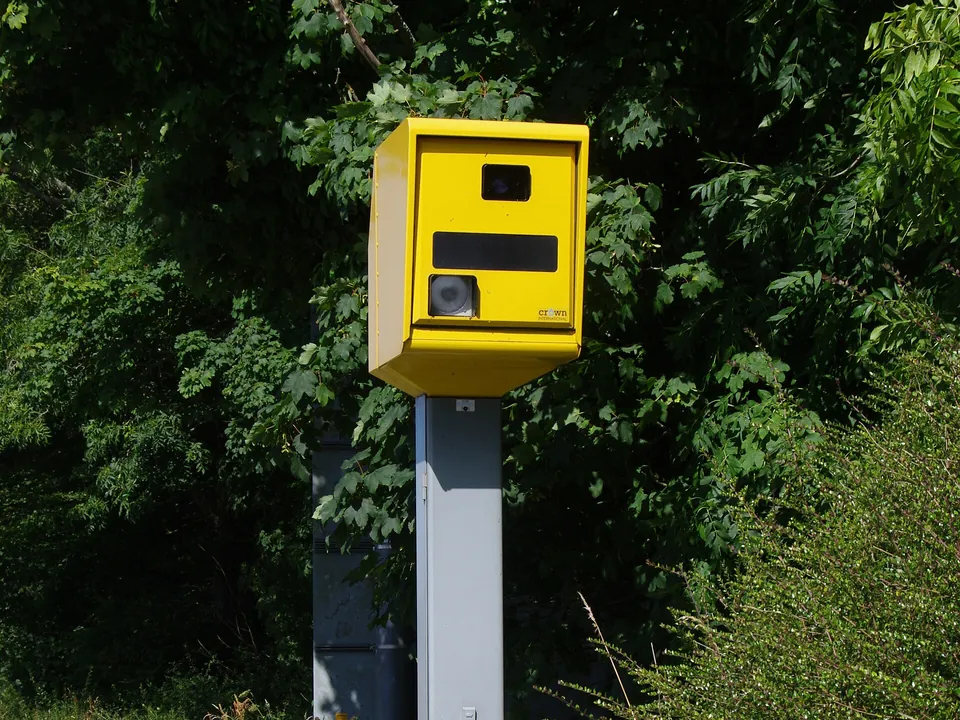
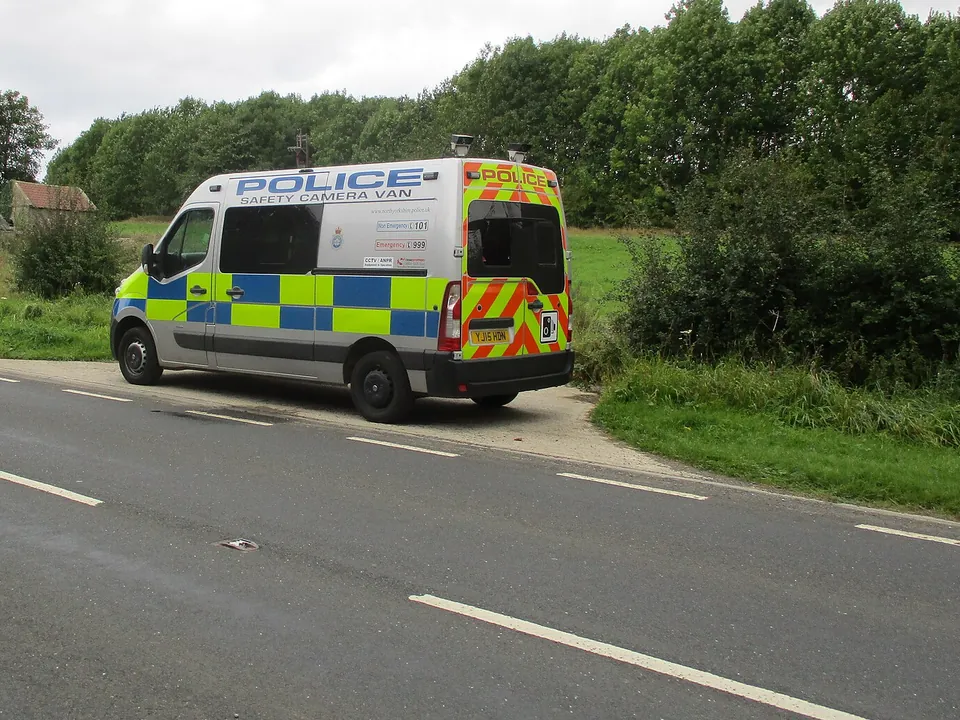
Fixed speed cameras are painted yellow or covered in yellow reflective sheeting, and are signposted with a camera sign. Police also use marked mobile camera vans, average speed cameras, red light cameras and cameras that enforce red X lane closures on smart motorways.

A yellow speed camera on a grey pole beside a road verge
Tresawls Road, Truro, CornwallPhoto: Mutney, CC0

Fixed speed camera

Signposted

Speed camera (safety camera)

Looks like: A box on a pole beside the road, painted yellow or covered in yellow reflective sheeting. Some photograph the back of the car after it passes. Others photograph approaching cars from the front, including the driver.

Catches: Speeding.

Guidance says the camera should be visible from 60 metres where the limit is 40 mph or less, and from 100 metres elsewhere.

A police safety camera van parked at the side of a country road
B6271, North YorkshirePhoto: Martin Dawes, CC BY-SA 2.0

Mobile camera

Sometimes signposted

Mobile safety camera van

Looks like: A van in enforcement livery parked at the roadside. An operator working away from the van wears high-visibility clothing.

Catches: Speeding.

Police officers also use hand-held laser or radar speed guns from the roadside or from police vehicles.

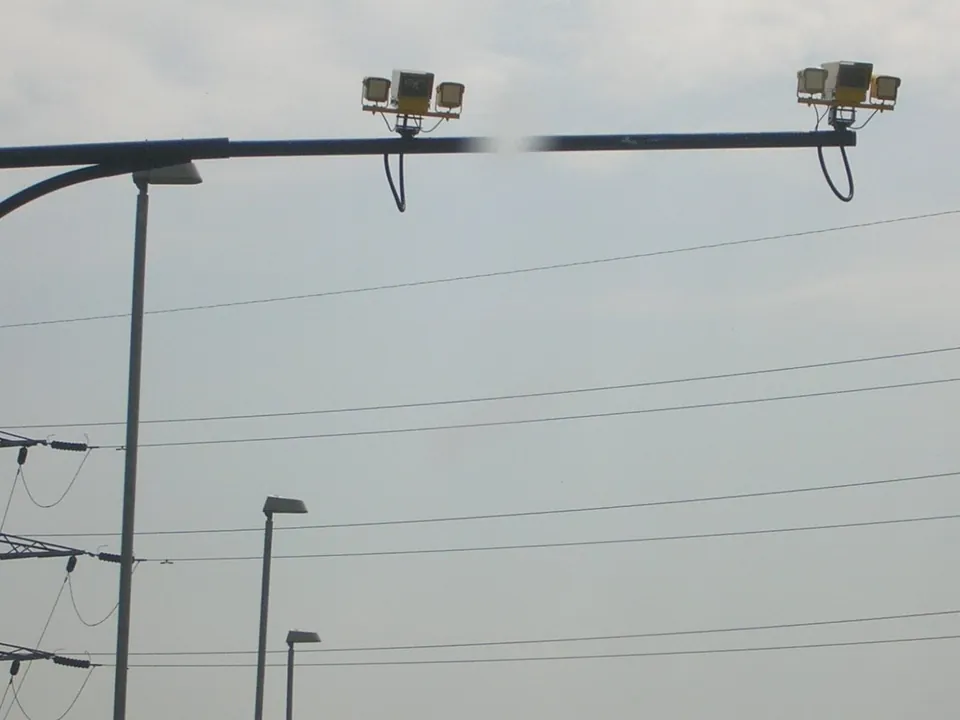
Average speed cameras on an overhead arm above a motorway
M1 southbound, junctions 11 to 10Photo: DeFacto, CC BY-SA 2.5

Average speed camera

Signposted

Average speed cameras

Looks like: Yellow cameras at two or more points along the road, which read number plates and work out the average speed between them.

Catches: An average speed above the limit between the camera points.

Used along stretches with scattered collisions and through roadworks, often with a 50 mph limit on motorway roadworks.

Every camera type in the United Kingdom, the warning signs and how fines reach you

Licence and International Driving Permits

Licence fromPermitNotes
the EU, IcelandNot neededVisitors with an EU or EEA licence can drive for up to 12 months from when they enter Great Britain. GOV.UK does not ask for an International Driving Permit.
Australia, New Zealand, United States, Canada, SwitzerlandNot neededVisitors can drive any small vehicle, such as a car, listed on a full and valid licence for 12 months from when they last entered Great Britain. GOV.UK does not ask for an International Driving Permit.
JapanRecommendedGOV.UK lets visitors drive on a full, valid licence for 12 months. Hire companies such as Enterprise require an International Driving Permit when a licence is written in a different language or script, so bring one.

What to carry

  • Your full, valid driving licence (the physical card)
  • An International Driving Permit, if your licence is not in English
  • Passport or other photo ID
  • A green card or other proof of insurance, if you bring your own car insured in the EU or certain other European countries

Zones and tolls

Congestion Charge

Charging hours are 7am to 6pm Monday to Friday, and 12pm to 6pm on Saturdays, Sundays and bank holidays. TfL suspended the charge from 25 December 2025 to 1 January 2026. Driving in the zone during charging hours costs £18 a day if paid in advance or on the day, or £21 if paid by midnight on the third day after travel. Electric cars get 25 per cent off only when registered for Auto Pay. Where: Central London. Fine: £180, reduced to £90 if paid within 14 days. It rises to £270 if not paid or challenged within 28 days.

Tip: When you hire a car, paying the charge is your job. If the hire company has to deal with a penalty for you, it adds a fee. Budget charges £25 plus VAT.

Ultra Low Emission Zone (ULEZ)

Petrol cars must meet Euro 4 and diesel cars Euro 6, or pay £12.50 a day. The zone runs 24 hours a day, every day except Christmas Day. Where: All London boroughs, up to but not including the M25. Fine: £180, reduced to £90 if paid within 14 days.

Tip: Vehicles registered outside the UK must be registered with TfL's partner EPC plc, even if they meet the standards.

Clean Air Zones

Only Birmingham and Bristol charge private cars. Cars that meet Euro 4 (petrol) or Euro 6 (diesel) don't pay. Other cars pay £8 a day in Birmingham, inside the A4540 Middleway ring road, and £9 a day in Bristol, where the charge runs midnight to midnight every day. Where: Bath, Birmingham, Bradford, Bristol, Portsmouth, Sheffield and Tyneside (Newcastle and Gateshead) Fine: £120 plus the daily charge in Bristol, reduced to £60 plus the charge if paid within 14 days. Birmingham's penalty is also £120.

Tip: Pay on GOV.UK up to 6 days before you travel or by 11:59pm on the sixth day after you drive in.

Low Emission Zones (Scotland)

Petrol cars must meet Euro 4 and diesel cars Euro 6. Vehicles that don't meet the standard can't pay to enter. Cameras check every vehicle 24 hours a day, including public holidays, and the registered keeper of a vehicle that doesn't meet the standard gets a penalty charge notice. Where: City centres of Aberdeen, Dundee, Edinburgh and Glasgow. Fine: £60 for a car, reduced to £30 if paid within 14 days. It doubles with each further breach, up to £480, and goes back to £60 after 90 days without a breach.

Tip: You can't register or pay in advance. The online vehicle checker can't check vehicles registered outside the UK.

Tolls

The Dartford Crossing on the M25 east of London charges cars £3.50 between 6am and 10pm, paid online, by phone or with cash at a Payzone shop by midnight the day after you cross. Two tunnels in east London also charge. The M6 Toll near Birmingham has barriers where you pay by contactless card.

  • Dartford Crossing: crossings between 10pm and 6am are free.
  • Dartford Crossing: the charge applies at weekends and on bank holidays too.
  • Dartford Crossing: drivers with a pre-pay Dart Charge account pay £2.80 per crossing.
  • Dartford Crossing: you can also pay for future crossings in advance.
  • Dartford Crossing: if you don't pay in time you get a £70 penalty on top of the charge. It is cut to £35 if paid within 14 days and rises to £105 if it is not paid within 28 days.
  • Blackwall and Silvertown tunnels (east London): cars pay £4 at peak times, northbound 6am to 10am and southbound 4pm to 7pm, and £1.50 for other trips between 6am and 10pm. TfL suspends these charges on Christmas Day.
  • M6 Toll: tap a contactless card at the toll plaza reader to open the barrier. The price depends on the vehicle and where you join and leave.
  • Northern Ireland has no road tolls.

Fuel and parking

At the pumpMeans
PetrolGasoline
E10The standard grade of petrol, sold as unleaded
E5 (super unleaded)Super grade petrol, 97 octane or higher
DieselDiesel
  • Double yellow lines mean no waiting at any time, even when there are no upright signs.
  • Single yellow lines mean no waiting during the times shown on nearby plates.
  • Red lines mark red routes. You must not stop on them unless signs say you can.
  • You must not stop or park on a pedestrian crossing or its zig-zag lines, on a clearway, or in a taxi bay.
  • Don't park within 10 metres of a junction unless it is an authorised parking space.
  • You must not park partly or wholly on the pavement in London or Scotland. Elsewhere, only do it where signs allow.
  • At night you must park facing the same direction as the traffic flow, unless you are in a recognised parking space.
  • In Scotland you must not double park or park where the kerb has been lowered for pedestrians or cyclists.

Driving in the cities

London

Central London has a Congestion Charge of £18 a day, or £21 if paid by midnight on the third day after travel. It applies from 7am to 6pm on weekdays and 12pm to 6pm at weekends and on bank holidays.

The Ultra Low Emission Zone covers all London boroughs and charges £12.50 a day to vehicles that don't meet the standards.

The Blackwall and Silvertown tunnels under the Thames in east London charge cars £1.50 off-peak and £4 at peak times.

Red lines mark red routes, where stopping is banned.

Bus lane and yellow box junction penalties in London are £160, halved if paid within 14 days.

You must not park on the pavement anywhere in London.

Edinburgh and Glasgow

Both city centres are low emission zones. Petrol cars must meet Euro 4 and diesel cars Euro 6, and cameras check every vehicle 24 hours a day.

A car that doesn't meet the standard brings a £60 penalty, doubling for repeat breaches. You can't pay to enter.

The drink-drive limit in Scotland is 50 mg per 100 ml of blood, lower than in England.

Pavement parking and double parking are banned in Scotland.

Birmingham

Roads inside the A4540 Middleway ring road form a Clean Air Zone. The ring road itself is not included.

Cars that don't meet Euro 4 (petrol) or Euro 6 (diesel) pay £8 a day. Pay on GOV.UK up to 6 days before or by 11:59pm on the sixth day after you drive in.

Questions people ask about driving in the United Kingdom

Can you turn left on a red light in the UK?

No. You must not cross the stop line while the light is red. Only a green filter arrow lets you go.

What does the national speed limit sign mean in the UK?

It means the national limit for the road type applies. For a car that is 60 mph on a single carriageway and 70 mph on a dual carriageway or motorway.

Can I drive in the UK on my foreign licence?

Yes. Visitors can drive a car on a full, valid licence for 12 months from when they last entered Great Britain. Northern Ireland also allows 12 months. Hire companies may ask for an International Driving Permit if your licence is not in English.

What is the drink-drive limit in Scotland?

50 mg of alcohol per 100 ml of blood, or 22 micrograms per 100 ml of breath. In England, Wales and Northern Ireland it is 80 mg and 35 micrograms.

Do I have to pay the London Congestion Charge in a hire car?

Yes, if you drive in the zone from 7am to 6pm on a weekday, or 12pm to 6pm at a weekend or on a bank holiday. The driver pays it, not the hire company. It costs £18 a day, or £21 if paid by midnight on the third day after travel. An unpaid charge brings a £180 penalty and usually a hire company fee.

What does a red X on a motorway mean?

The lane is closed. You must not drive in it. Cameras enforce this, and the penalty is £100 and 3 points.

How do I pay the Dartford Crossing charge?

Pay online, by phone or with cash at a Payzone shop, by midnight the day after you cross. A car costs £3.50 between 6am and 10pm.

Can I hold my phone at traffic lights in the UK?

No. Holding a phone while driving is illegal even when stopped at lights or queuing. The penalty is £200 and 6 penalty points.

Driving in the United Kingdom soon?

Get the before-you-drive checklist for the United Kingdom by email, with what to carry, what to check on the hire car, and the rules people get fined for.

The checklist now, one more email a few days later, and a reminder before you drive if you add the date. Unsubscribe any time.

The United Kingdom for drivers from…

The same guide, with only what's different from home.

Sources

Checked 15 October 2026. Official sources first.

  1. Speed limits GOV.UK
  2. The Highway Code: Traffic signs GOV.UK (Department for Transport)
  3. The Highway Code: Using the road (159 to 203) GOV.UK (Department for Transport)
  4. The Highway Code: Motorways (253 to 274) GOV.UK (Department for Transport)
  5. The Highway Code: General rules, techniques and advice for all drivers and riders (103 to 158) GOV.UK (Department for Transport)
  6. The Highway Code: Waiting and parking (238 to 252) GOV.UK (Department for Transport)
  7. The Highway Code: Breakdowns and incidents (274 to 287) GOV.UK (Department for Transport)
  8. The drink drive limit GOV.UK
  9. Road Safety Strategy plans to reduce drink-drive limit Institute of Alcohol Studies
  10. Using mobile phones when driving: the law GOV.UK
  11. Speeding penalties GOV.UK
  12. Circular 01/2007: Use of speed and red-light cameras for traffic enforcement: guidance on deployment, visibility and signing Department for Transport
  13. Camera enforcement of 'red X' offences begins Road Safety GB
  14. Driving in Great Britain on a non-GB licence: visitor with an EU or EEA licence GOV.UK
  15. Driving in Great Britain on a non-GB licence: visitor with a licence from any other country GOV.UK
  16. 20mph Welsh Government
  17. Next steps in reviewing the national default speed limit for Wales Rhondda Cynon Taf County Borough Council
  18. National Speed Management Review consultation: proposed speed limit changes Transport Scotland
  19. Dart Charge price change National Highways
  20. Pay the Dartford Crossing charge (Dart Charge) GOV.UK
  21. Dart Charge: fines (penalty charge notices) GOV.UK
  22. Notice 02/26: changes to the Congestion Charge scheme Transport for London
  23. London Congestion Charge increases BVRLA (British Vehicle Rental and Leasing Association)
  24. Transport for London road user charging notice (penalty charges) The London Gazette
  25. London Congestion Charge: cost, zone map, times and how to pay (2026 guide) Visit London
  26. London Congestion Charge Budget UK
  27. Ultra Low Emission Zone Transport for London
  28. Clean air zones GOV.UK
  29. Driving in a clean air zone GOV.UK
  30. Low emission zones mygov.scot (Scottish Government)
  31. Questions and answers Safety Cameras Scotland
  32. E10 petrol explained GOV.UK
  33. Speed limits in the United Kingdom Wikipedia
  34. Road speed limit enforcement in the United Kingdom Wikipedia
  35. Road signs in the United Kingdom Wikipedia
  36. Majority of TfL services running over Christmas and New Year (press release, 2 December 2025) Transport for London
  37. Greater London (Central Zone) Congestion Charging (Variation) Order 2025 (notice) The London Gazette
  38. Green light for Graduated Driver Licensing in October Department for Infrastructure (Northern Ireland)
  39. What is needed to hire a car? Enterprise Rent-A-Car UK
  40. Blackwall and Silvertown tunnel toll increase 2026 The Greenwich Wire
  41. M6 Toll pricing and payment M6toll
  42. Average speed enforcement cameras National Highways
  43. Speed camera and radar detectors: are they legal in the UK? Confused.com
  44. PCN charges Wandsworth Council
  45. London's Ultra Low Emission Zone Embassy of the Czech Republic in London
  46. Plans to reduce speed limits on Scottish roads dropped Road Safety GB
  47. Driving in Northern Ireland: road safety advice for visitors nidirect (Northern Ireland government)
  48. Advice on foreign driving licences in Northern Ireland nidirect (Northern Ireland government)
  49. Pay the Bristol Clean Air Zone daily charge Bristol City Council
  50. Low Emission Zone Aberdeen City Council
  51. Birmingham's Clean Air Zone charging begins CILT(UK)
  52. What vehicles you can drive GOV.UK