Driving in Japan: the road rules for visitors

Checked 15 October 2026 against official sources

In Japan you drive on the left, with the steering wheel on the right, and roundabouts go clockwise. At junctions without signs or road markings, traffic from your left goes first, even from a small side street.

Watch for fixed and mobile cameras, and for unmarked camera cars.

LeftSide of the road
60km/h in towns
60km/h on country roads
100km/h on motorways
0.03blood alcohol limit
Noturning left on red
Limitedearphones while driving
110 (police) or 119 (ambulance and fire)emergency number

The rules that catch visitors out

The most important first.

  1. Stop at every railway crossing

    Stop before every railway crossing, at the stop line if there is one. Look both ways and listen for trains, then cross. This applies even when the barriers are up and no alarm is sounding. The only exception is a crossing with its own traffic lights showing that you can go.

  2. The stop sign is a red triangle

    Japan's stop sign is a red triangle pointing down, with 止まれ (tomare) in white. Newer signs also say STOP. Stop completely at the line and check both ways. Police enforce this strictly.

  3. No turning on red

    A red light means stop for every direction, including left turns. Only a green arrow lets you go, and only the way it points.

  4. 30 km/h on roads without a centre line

    Since 1 September 2026, the default limit on roads without a centre line, lane lines or a central barrier is 30 km/h. Roads with them stay at 60 km/h unless signposted.

  5. Any alcohol is illegal, and others are liable too

    Do not drive after drinking any alcohol, and do not drive with a hangover. Anyone who lends you the car, gives you alcohol when you are going to drive, or asks to ride with you after you have been drinking can also be punished.

  6. Only a 1949 Geneva Convention IDP is valid

    Japan does not accept IDPs issued under the 1968 Vienna Convention, or card and smartphone IDPs. Drivers from Switzerland, Germany, France, Belgium, Monaco and Taiwan need an official Japanese translation of their licence instead.

  7. Stop for pedestrians at crossings

    Approach pedestrian crossings at a speed that lets you stop. If anyone is crossing or about to cross, stop before the crossing and let them go. If a vehicle has stopped at a crossing, stop before you pass it.

  8. Traffic from the left goes first at unmarked junctions

    At a junction without lights or signs, give way to vehicles coming from your left. If the other road is a priority road or clearly wider, it goes first whichever side it is on. A road whose centre line runs through the junction counts as a priority road.

8 more rules worth knowing

Roundabouts go clockwise

Go clockwise and give way to traffic already on the roundabout, which comes from your right.

Right turns give way to oncoming traffic

When you turn right, oncoming vehicles going straight or turning left go first. Wait with your indicator on until they and any pedestrians have passed.

Give cyclists room or slow down

Since 1 April 2026, if you cannot leave enough space when passing a cyclist, you must slow to a speed that is safe for the gap. JAF recommends at least 1.5 metres, or crawling speed. Breaking the rule costs ¥7,000 and 2 points. Do not cross a solid yellow centre line to get past a cyclist. Slow down and pass within your lane.

Yellow centre line means no overtaking

A solid yellow centre line means you must not cross into the opposite lane to overtake.

Report every accident to the police

After any accident, call the police on 110, even if nobody is hurt. If someone is injured, give first aid and call an ambulance on 119.

No passing on the left

On motorways, overtaking on the left is banned. Keep to the left-hand lane unless you're overtaking. Keep to the leftmost lane. On roads with three or more lanes in your direction, you may use any lane except the rightmost one, depending on your speed.

Bus lanes in Okinawa

Most bus lanes apply from 7:30 to 9:00 and from 17:30 to 19:00 on weekdays, and some routes have other hours. They do not apply at weekends, on public holidays or on 2 and 3 January. During those hours, only buses and the other vehicles shown on the signs may use them. Where: Main roads in Naha, Urasoe and Ginowan, including parts of Route 58, Route 29, Route 222, Route 329, Route 330 and Kokusai Street. Fine: About ¥6,000 to ¥7,000. Some bus lanes are coloured green, but not all, so read the signs. You may move into a bus lane to turn left only when you are close to the junction.

Toll roads

Most expressways charge a toll based on distance. You pay at toll gates in cash, by credit card or with an ETC card. Toll lanes with a green sign take cash and credit cards. Lanes with a purple sign are for ETC cards. Hire companies can supply an ETC card. The tolls are settled when you return the car.

Speed limits

Where no sign says otherwise, in kilometres per hour.

60
Towns and cities
Japan sets default limits by type of road, not by town. Roads with a centre line, lane lines or a central barrier default to 60 km/h. Since 1 September 2026, roads without them, such as narrow residential streets, default to 30 km/h.
60
Country roads
The same defaults apply outside towns: 60 km/h on roads with a centre line, lane lines or a central barrier, and 30 km/h on roads without them.
60
Dual carriageways
Motor-vehicle-only roads (自動車専用道路) that are not national expressways default to 60 km/h unless a sign shows otherwise. So do the parts of national expressways outside the main carriageway and its merge and exit lanes.
100
Motorways
National expressways (高速自動車国道). Many sections are signposted lower, often 80 km/h, and 70 km/h where there is one lane each way. Some sections are signposted 110 or 120 km/h, including parts of the Shin-Tomei and Tohoku expressways.
  • The defaults apply only where no limit is posted. A posted limit always replaces them.
  • The 30 km/h default took effect on 1 September 2026. Before that, roads without a centre line defaulted to 60 km/h, so older guides that give 60 km/h for all ordinary roads are out of date.
  • Speed limit signs show the number only, with no unit. The limit can also be painted on the road in large yellow numbers.

Who goes first

Look right first

YouFrom your rightFrom your left
You stop at the stop line.
Traffic keeps to the left here, so the lane nearest you carries cars coming from your right. Look right, then left, then right again before you pull out.

Priority to the left

YouGoes first
Both cars arrive at a junction with no signs or lines.
At a junction with no signs, signals or road markings, the car coming from your left goes first, even from a small side street.

When your road has priority

YouGives way
You are on a priority road, shown by the yellow diamond.
The yellow diamond means your road has priority and side roads have a give way line. Watch for the same diamond with a black bar across it, which means priority to the left is back.

The app animates all 7 junctions for Japan, including the ones above.

Open it in the app

Signs to know

止まれSTOPStop止まれ (tomare)

Stop completely at the stop line before the junction.

徐行 (JOKŌ)Slow down徐行 (jokō)

Drive slowly enough to stop immediately, as a guide 10 km/h or less.

Slow down, priority road ahead徐行 with 前方優先道路 (zenpō yūsen dōro)

The road ahead has priority.

50Maximum speed最高速度 (saikō sokudo)

Maximum speed in km/h.

No entry車両進入禁止 (sharyō shinnyū kinshi)

No entry for vehicles from this direction, usually the exit of a one-way street.

One way一方通行 (ippō tsūkō)

Traffic may only go in the direction of the arrow.

車両通行止め(SHARYŌTSŪKŌDOME)Road closed to vehicles車両通行止め (sharyō tsūkōdome)

No vehicles, including bicycles.

通行止(TSŪKŌDOME)Road closed通行止 (tsūkōdome)

Closed to everyone, including pedestrians.

Railway crossing ahead踏切あり (fumikiri ari)

There is a railway crossing ahead.

Pedestrian crossing横断歩道 (ōdan hodō)

Marks a pedestrian crossing.

No overtaking into the right side of the road追越しのための右側部分はみ出し通行禁止 (oikoshi no tame no migigawa bubun hamidashi tsūkō kinshi)

Do not cross into the right side of the road to overtake. With the 追越し禁止 plate, do not overtake at all.

歩行者専用(HOKŌSHASEN'YŌ)Pedestrians only歩行者専用 (hokōsha sen'yō)

Road for pedestrians only. Vehicles are not permitted.

All 29 road signs in Japan, explained

Speed cameras

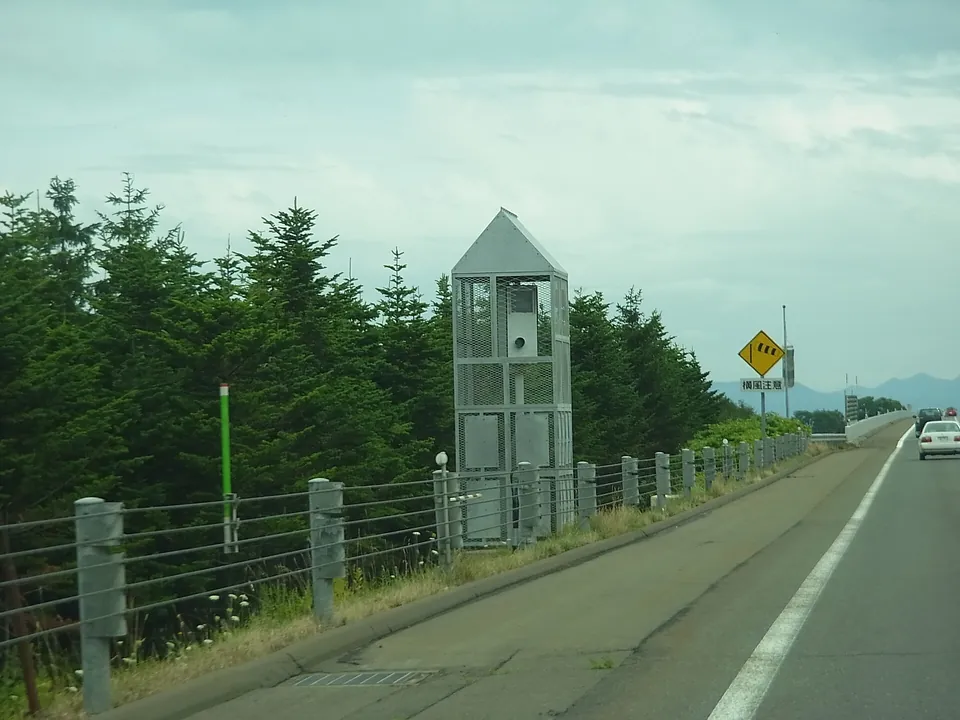
Fixed speed cameras, called Orbis, usually have warning signs 1 to 3 km before them. Portable cameras on residential roads and school routes, and police speed traps, usually do not.

A tall Orbis speed camera housing behind wire mesh beside a highway
HokkaidoPhoto: Ab11, CC BY 3.0

Fixed speed camera

Signposted

オービス (Orbis), loop coil type

Looks like: A camera unit beside or above the road, usually behind wire mesh. Three sensor loops are buried in the road, and the spot is marked with white lines or notched grooves in the road surface.

Catches: Speeding.

It does not transmit, so ordinary radar detectors cannot sense it.
Fixed speed camera

Signposted

オービス (Orbis), radar type

Looks like: A camera on the central reserve or the roadside, with a radar antenna about 10 metres ahead of it over the road.

Catches: Speeding.

Used where loops are hard to install, such as busy roads.

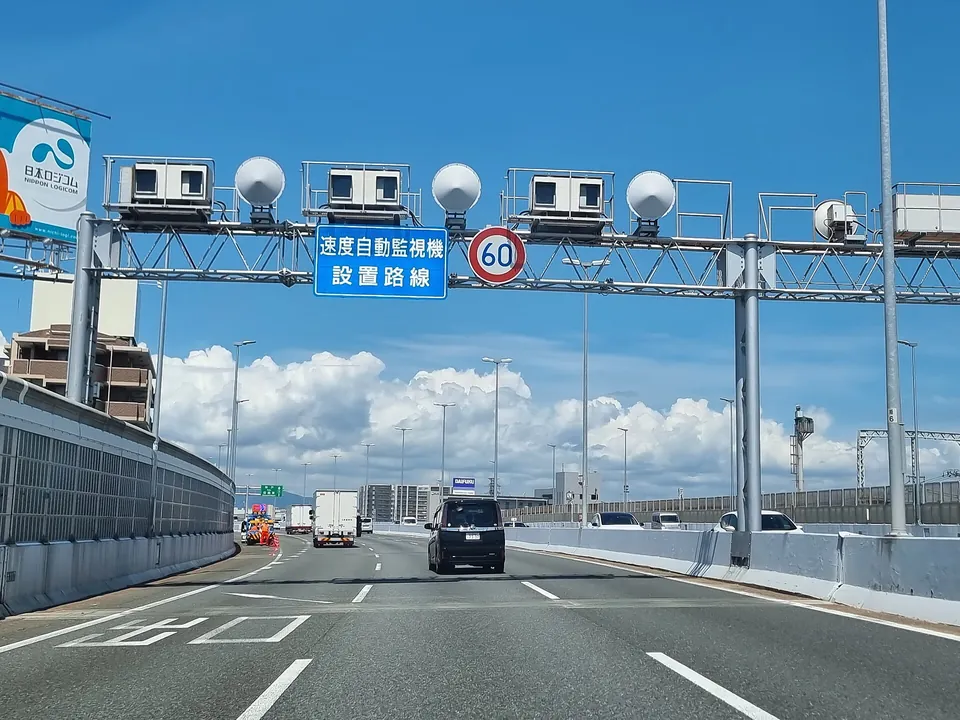
Speed cameras and flash units on a gantry over an expressway, with a sign saying speed is monitored automatically
Hanshin Expressway, between Osaka and KobePhoto: Benlisquare, CC BY-SA 4.0

Fixed speed camera

Signposted

Hシステム and LHシステム (H and LH systems)

Looks like: A camera housing on a gantry over the road. Some H systems are paired with an electronic board that lights up 速度落とせ (slow down). LH systems use loops in the road marked with white lines, and some are inside tunnels.

Catches: Speeding.

The most common fixed type.

Every camera type in Japan, the warning signs and how fines reach you

Licence and International Driving Permits

Licence fromPermitNotes
Australia, New Zealand, United Kingdom, Ireland, United States, Canada, IcelandRequiredYou need an IDP issued under the 1949 Geneva Convention, the paper booklet (148 by 105 mm), carried with your home licence and passport. It must have a stamp in category B for cars. Card and smartphone IDPs are not valid.
the EURequiredMost EU countries issue the 1949 Geneva IDP that Japan accepts. The exceptions are Germany, France and Belgium, whose drivers need an official Japanese translation instead, and Bulgaria, whose IDPs are not accepted. Latvia is not on the Tokyo police list of Geneva Convention countries, so Latvian drivers should check with the Japanese embassy first.
Switzerland, Germany, France, BETranslation neededIDPs from these countries are not valid in Japan. Carry your licence with an official Japanese translation from JAF, from your country's embassy or consulate in Japan, or for German licences from ADAC. Translations by other translators, even certified ones, are not accepted. Monaco and Taiwan licences use the same route.
BGNot acceptedBulgaria does not issue the Geneva-format IDP that Japan accepts, and Bulgarian licences are not on the list that can be used with a translation.
JapanNot neededA Japanese licence is valid.

What to carry

  • Passport, with your entry stamp
  • Home driving licence
  • 1949 Geneva Convention IDP, the paper booklet, or an official Japanese translation if your licence is from Switzerland, Germany, France, Belgium, Monaco or Taiwan

Zones and tolls

Bus lanes in Okinawa

Most bus lanes apply from 7:30 to 9:00 and from 17:30 to 19:00 on weekdays, and some routes have other hours. They do not apply at weekends, on public holidays or on 2 and 3 January. During those hours, only buses and the other vehicles shown on the signs may use them. Where: Main roads in Naha, Urasoe and Ginowan, including parts of Route 58, Route 29, Route 222, Route 329, Route 330 and Kokusai Street. Fine: About ¥6,000 to ¥7,000.

Tip: Some bus lanes are coloured green, but not all, so read the signs. You may move into a bus lane to turn left only when you are close to the junction.

Tolls

Most expressways charge a toll based on distance. You pay at toll gates in cash, by credit card or with an ETC card.

  • Toll lanes with a green sign take cash and credit cards. Lanes with a purple sign are for ETC cards.
  • Hire companies can supply an ETC card. The tolls are settled when you return the car.
  • Some toll gates are ETC-only, and manual toll gates are being phased out. If you enter an ETC lane without a working ETC card, do not reverse. Use the lane marked ETC/Support or Support, stop, and follow the signs and the staff.
  • The nationwide Japan Expressway Pass and the Central Nippon Expressway Pass are no longer available.
  • Regional passes for foreign visitors cover tolls in one area for a fixed price. You need a non-Japanese passport, your licence and IDP, and an ETC card hired with the car. Prices do not include the car or the ETC card.
  • Hokkaido Expressway Pass: ¥7,700 for 4 days up to ¥15,400 for 8 days for an ordinary car.
  • Tohoku Expressway Pass (Akita, Aomori, Fukushima, Iwate, Miyagi and Yamagata): ¥8,500 for 4 days up to ¥17,000 for 8 days for an ordinary car.
  • San'in-Setouchi-Shikoku Expressway Pass: ¥10,700 for 3 days up to ¥17,700 for 10 days.
  • Kyushu Expressway Pass: ¥6,200 for 2 days up to ¥23,800 for 10 days.

Fuel and parking

At the pumpMeans
軽油 (keiyu)Diesel. 軽 means light, but it is not fuel for kei (light) cars, which almost never have diesel engines. Easy to get wrong
ディーゼル (dīzeru)Diesel. Some stations use this word instead of 軽油 to stop people misfuelling kei cars. Easy to get wrong
  • Parking can be hard to find in city centres, and free street parking is rare.
  • Parking outside designated spaces can lead to a penalty.
  • Many coin car parks have a locking plate that rises under the car after you park. To leave, enter your space number at the machine and pay. The plate drops, but it rises again after a set time, so drive off promptly.
  • On expressways you must not stop or park except in parking areas, at toll booths, or on the hard shoulder when a breakdown leaves you no choice.

Seasons and weather

  • In snowy areas, winter tyres or snow chains are needed.
  • A blue round sign with a white tyre wrapped in chains means the road is closed to vehicles without tyre chains. Winter tyres alone are not enough there.

Driving in the cities

Naha (Okinawa)

Bus lanes on main roads in Naha, Urasoe and Ginowan, including Route 58 and Kokusai Street, mostly apply from 7:30 to 9:00 and from 17:30 to 19:00 on weekdays. Keep out of them during those hours unless the signs allow your vehicle.

The expressway in Okinawa is signposted at 80 km/h. Its toll booths take cash, and an ETC card from the hire company speeds things up.

Okinawa's limestone road surfaces can be slippery, especially after rain.

Free street parking is rare. Many coin car parks use locking plates that rise under the car.

Sapporo (Hokkaido)

The Hokkaido Expressway Pass covers expressway tolls in its area for 4 to 8 days, from ¥7,700 to ¥15,400 for an ordinary car. Hire the ETC card with the car.

In winter, winter tyres or snow chains are needed. A blue sign with a tyre in chains means chains are compulsory.

Tokyo

Tokyo's road traffic rules ban driving when you cannot hear the traffic around you, for example while listening to the radio through earphones.

Parking is hard to find and free street parking is rare. Plan to use car parks.

Questions people ask about driving in Japan

Can you turn left on a red light in Japan?

No. A red light means stop for every turn. Only a green arrow lets you go, in the direction it points.

Which International Driving Permit do I need for Japan?

A paper IDP issued under the 1949 Geneva Convention, with category B stamped for cars. Drivers with licences from Switzerland, Germany, France, Belgium, Monaco or Taiwan need an official Japanese translation instead.

How long can I drive in Japan on a foreign licence?

Up to one year from the day you arrive, or until your IDP or licence expires if that is sooner.

What is the speed limit in Japan?

Unless a sign says otherwise, 60 km/h on ordinary roads with a centre line, 30 km/h on roads without one since 1 September 2026, and 100 km/h on national expressways. Some expressway sections are signposted 110 or 120 km/h.

Do you have to stop at railway crossings in Japan?

Yes. Stop before every crossing, look both ways and listen, then cross. The only exception is a crossing with its own traffic lights showing that you can go.

What is the drink driving limit in Japan?

Driving after any alcohol is illegal. The criminal threshold is 0.15 mg per litre of breath, about 0.03 per cent blood alcohol. Passengers and anyone who supplied the drink or the car can also be punished.

Is the Japan Expressway Pass still sold?

No. The nationwide pass is no longer sold. Regional passes for Hokkaido, Tohoku, San'in-Setouchi-Shikoku and Kyushu are available through hire companies, used with an ETC card.

What does a stop sign look like in Japan?

A red triangle pointing down, with 止まれ (tomare) written in white. Newer ones also say STOP.

Driving in Japan soon?

Get the before-you-drive checklist for Japan by email, with what to carry, what to check on the hire car, and the rules people get fined for.

The checklist now, one more email a few days later, and a reminder before you drive if you add the date. Unsubscribe any time.

Japan for drivers from…

The same guide, with only what's different from home.

Sources

Checked 15 October 2026. Official sources first.

  1. For Holders of Foreign Driver's Licenses: How to Drive in Japan (May 2026) National Police Agency
  2. Follow the Rules for Safe Driving in Japan National Police Agency
  3. Follow the rules and drive safely in Japan National Police Agency
  4. Traffic Lights and Road Signs National Police Agency
  5. Eradication of Drinking and Driving National Police Agency
  6. Traffic Safety Rules (leaflet for visitors) National Police Agency
  7. Q&A related to international driver's licenses National Police Agency
  8. Road Traffic Act (道路交通法), current text e-Gov, Digital Agency
  9. Order for Enforcement of the Road Traffic Act (道路交通法施行令), current text e-Gov, Digital Agency
  10. 生活道路の法定速度の引下げ (lower default speed on residential roads) Osaka Prefectural Police
  11. Things to know when renting a car Japan National Tourism Organization
  12. Expressway Passes (updated 22 January 2026) Japan National Tourism Organization
  13. Valid Driving License (Drive in Japan) Japan Automobile Federation (JAF)
  14. 交通ルールクイズ: 運転中のハンズフリー通話 (May 2025) JAF Mate, Japan Automobile Federation
  15. Driving rules differ between Japan and foreign countries Japan Automobile Federation (JAF)
  16. ながら運転 penalties leaflet Miyagi Prefectural Police
  17. Traffic rules (English) Hokkaido Prefectural Police
  18. Traffic Rules in Japan (English leaflet) Gunma Prefectural Police
  19. Notification of Traffic Violations National Police Agency
  20. 自動速度違反取締装置 (automatic speed enforcement devices) Japanese Wikipedia
  21. レーダー探知機 (radar detectors) Japanese Wikipedia
  22. 軽油 (diesel fuel) Japanese Wikipedia
  23. 日本における速度規制 (speed regulation in Japan) Japanese Wikipedia
  24. Navigating the Roads of Japan: A Guide for International Visitors Japan CRC (camper hire)
  25. 飲酒運転の罰則等 (drink driving penalties leaflet, December 2024) Hokkaido Prefectural Police, Kushiro
  26. ジュネーブ条約締約国等に関する情報 (Geneva Convention countries and IDP formats, updated 2 July 2026) Tokyo Metropolitan Police Department
  27. What to Do in Case of Vehicle Trouble, etc. National Police Agency
  28. Child Seats Save Children National Police Agency
  29. クルマで自転車の横を通過する場合は間隔と速度に注意 (new rule from 1 April 2026, published 27 March 2026) JAF Mate, Japan Automobile Federation
  30. Hokkaido Expressway Pass NEXCO East (Drive Plaza)
  31. In March 2026, Yamada IC, Okegawa Kitamoto IC, and Wako IC will become ETC-only toll gates (17 February 2026) NEXCO East
  32. 警察庁における交通安全対策について (traffic safety measures, April 2023) National Police Agency Traffic Bureau, via Cabinet Office
  33. Rental Vehicles in Okinawa Okinawa Convention & Visitors Bureau
  34. 横断歩行者等妨害等違反 (failing to give way to pedestrians at crossings) Gunma Prefectural Police
  35. Driving in Japan: expressways (page updated 27 July 2026) japan-guide.com
  36. Driving in Okinawa Travel Japan (traveljapan.com.au)
  37. 「自転車追い越し」で黄色線はみ出したら違反? 警視庁に聞いてみた (31 July 2026) Kuruma News
  38. Know the law: stay out of Okinawa bus lanes because police are watching (8 March 2025) Stars and Stripes Okinawa
  39. 可搬式オービスによる取り締まり情報を警察がSNSで発信 (16 November 2025) Kuruma News