Speed cameras in Australia: what they look like

Checked 15 October 2026

NSW, Victoria and Queensland use fixed, red light, mobile and average speed cameras. NSW, Victoria, Queensland and the ACT also use cameras that catch phone use and unworn seatbelts. NSW puts warning signs before its fixed cameras, at red light camera intersections and around its marked mobile camera cars. Victoria's mobile cameras can work from unmarked cars and have no warning signs.

Warned by a sign

None

Not always warned

Fixed speed camera, Red light camera, Mobile camera

Every camera type

Real photos, with where each one was taken and who took it.

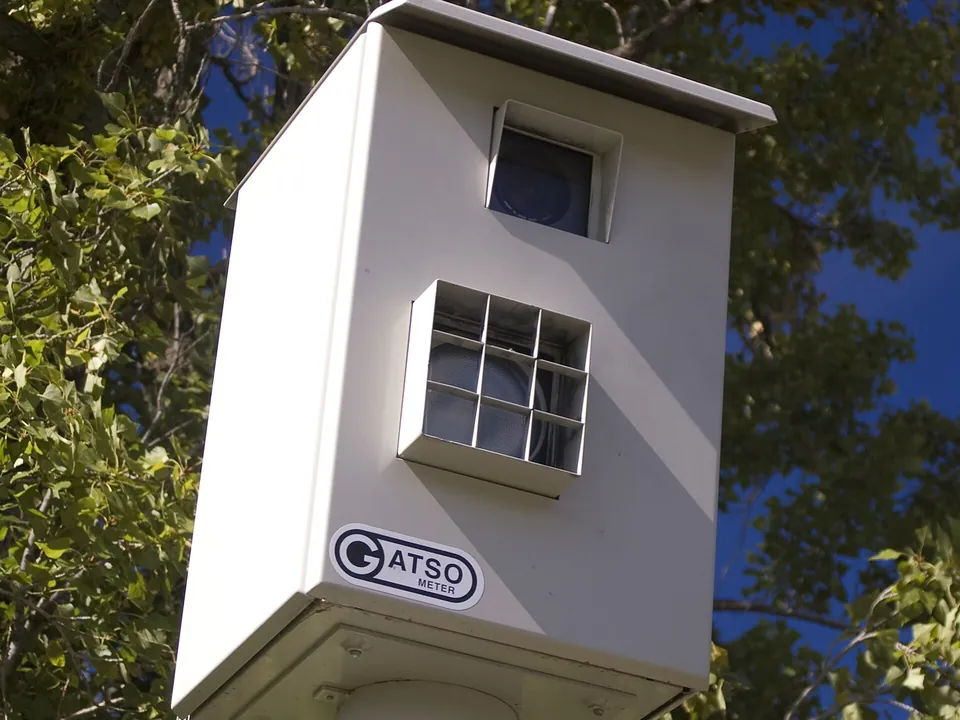
A white Gatso fixed speed camera housing on a pole
CanberraPhoto: Bidgee, CC BY-SA 3.0

Fixed speed camera

Sometimes signposted

Fixed speed camera

Looks like: A permanently installed camera at the roadside or at an intersection. In NSW, sensors in the road surface measure the speed.

Catches: Speeding. NSW fixed cameras can measure traffic in both directions and every lane.

In NSW, every fixed camera has three advance warning signs. They are used at high-risk places such as tunnels. Fixed cameras in NSW school zones work 24 hours a day and enforce the 40 km/h limit during school zone times.
Red light camera

Sometimes signposted

Red-light speed camera

Looks like: A camera usually on a pole or other structure, a few metres back from the stop line.

Catches: Crossing the stop line after the light turns red, and in NSW and Queensland also speeding through the intersection whether the light is red, yellow or green.

NSW signposts intersections with red-light speed cameras. If one camera catches both offences, NSW issues two fines.

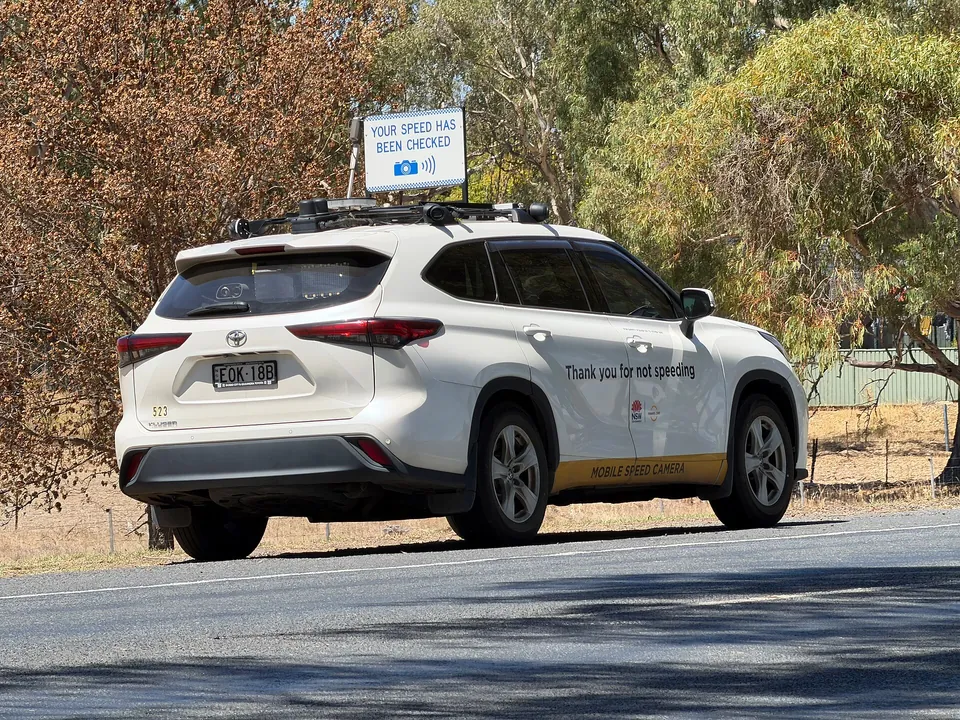
A white SUV with a raised roof sign saying your speed has been checked, parked at the roadside
Lake Albert Road, Wagga Wagga, New South WalesPhoto: Bidgee, CC BY-SA 3.0 AU

Mobile camera

Sometimes signposted

Mobile speed camera

Looks like: In NSW, a car with speed camera livery and a retractable sign on the roof that is raised during a session. In Victoria, an unmarked car, and from 2026 also unmarked trailers. In Queensland, marked or unmarked vehicles parked at the roadside, or a camera on a tripod run by police.

Catches: Speeding. Victorian units detect traffic in both directions across up to 6 lanes.

NSW places two portable warning signs before the camera car and one after it in every session. Victoria uses no warning signs and publishes a list of approved mobile camera locations each month. Queensland has up to 3,500 approved mobile camera sites.

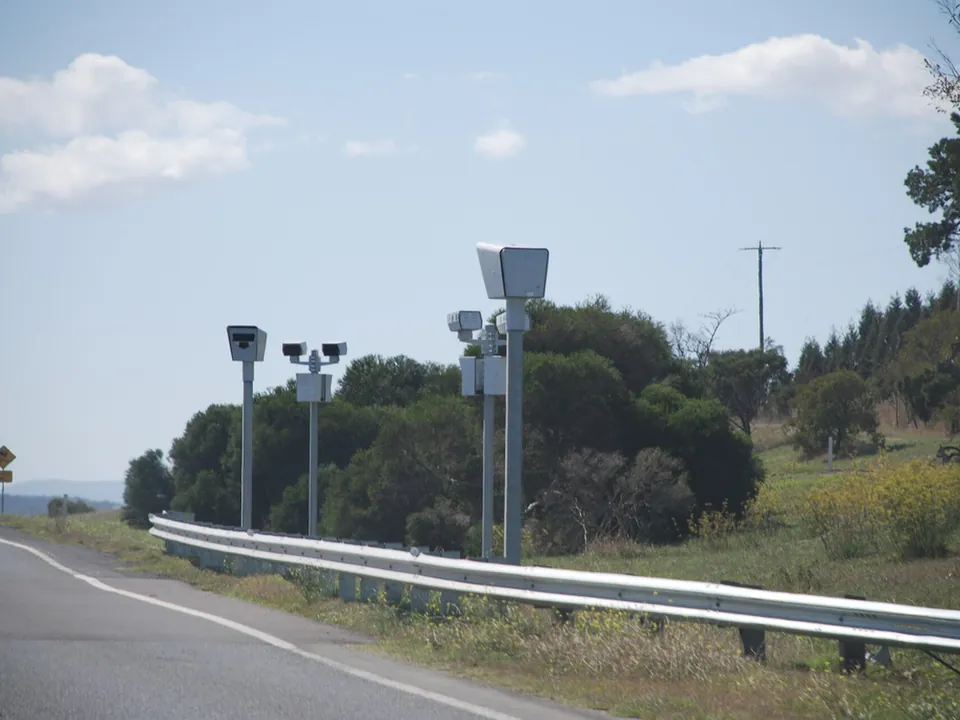
Point-to-point speed cameras on poles beside a highway
Hume Highway, VictoriaPhoto: davepaku, CC BY-SA 2.0

Average speed camera

Average speed or point-to-point camera

Catches: Average speed between two camera points. Victorian systems also take instant speed readings.

In NSW, average speed cameras long applied only to heavy vehicles. Since 1 July 2025 they also fine cars on two stretches: 16 km of the Hume Highway between Coolac and Gundagai, and 15 km of the Pacific Highway between Kew and Lake Innes. In Victoria, point-to-point cameras cover the Hume Highway and Peninsula Link. Queensland uses them on high-volume roads such as motorways and highways.

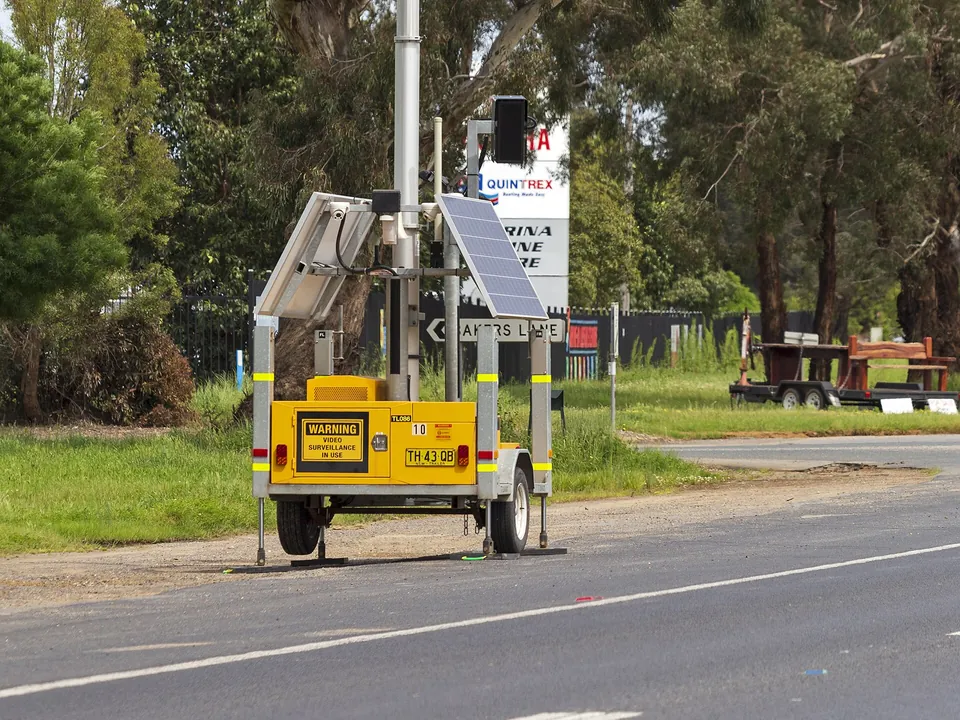
A trailer-mounted mobile phone detection camera beside a highway
Sturt Highway, Gumly Gumly, New South WalesPhoto: Robert Myers, CC BY-SA 3.0 AU

Phone and seatbelt camera

Mobile phone and seatbelt detection camera

Looks like: Fixed units mounted on existing roadside structures, and portable units moved between sites. NSW units use several cameras and an infrared flash.

Catches: Drivers holding or using a phone, and drivers and passengers not wearing a seatbelt or wearing it wrongly.

NSW has used phone cameras since March 2020 and added seatbelt checks from 1 July 2024. The ACT has used phone cameras since November 2023. Queensland's cameras use artificial intelligence and check the driver and front seat passenger. Victoria also uses them.

Other camera

Road safety camera trailer (Queensland)

Looks like: A highly visible trailer carrying a speed camera, 360-degree CCTV cameras and an alarm.

Catches: Speeding.

Used on highways and motorways, at roadworks and in school zones.

The warning signs

SPEED CAMERA24 HOURS

Speed camera warning (NSW)

SPEED CAMERA 24 HOURS

A fixed speed camera is ahead.

What to do: Check your speed. The camera works 24 hours a day.

  • Before every NSW fixed speed camera, three signs in a row. Each shows a camera symbol, a message and the speed limit. The messages, in order, are SPEED CAMERA 24 HOURS, then SPEED CAMERA AHEAD or SPEED CAMERA IN USE, then HEAVY FINES LOSS OF LICENCE. On the approach to the camera.
  • Around NSW mobile speed camera cars, two portable signs before the car and one after it, while the car's roof sign is raised. Before and just after the camera car.
  • At NSW intersections with red-light speed cameras, signs show that the cameras are installed and operating. At the intersection.

Good to know

Radar detectors: Illegal

If you're in a hire car: Camera fines go to the vehicle's registered owner, which for a hire car is the hire company. In NSW the owner is responsible until it names the driver, and companies must name the driver of a company vehicle. An overseas visitor is named using their passport number and country, and the fine then passes to them.

The full guide to driving in Australia · Speed cameras in other countries