Speed cameras in France: what they look like

Checked 15 October 2026

Fixed speed cameras are usually announced by signs, although the law does not require it. Red light and level crossing cameras, mobile radars and unmarked camera cars are never announced.

Warned by a sign

Fixed speed camera (Radar fixe), Fixed speed camera (Radar discriminant), Average speed camera

Not always warned

Red light camera, Level crossing camera, Mobile camera, Unmarked camera car

Every camera type

Real photos, with where each one was taken and who took it.

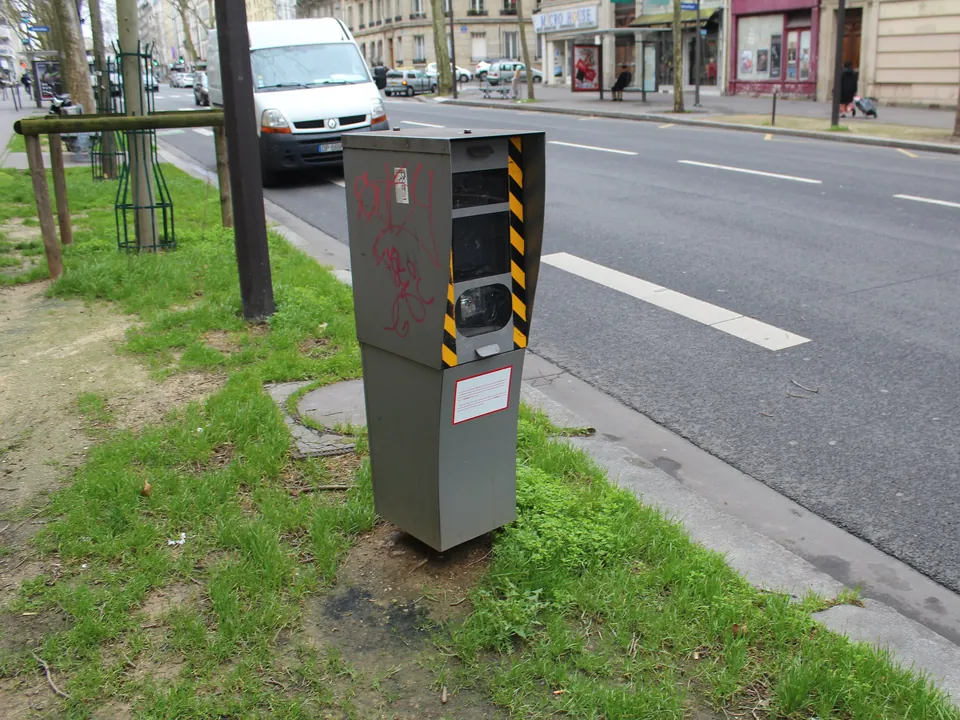
A grey speed camera box with yellow and black stripes on a post beside a Paris avenue
Avenue Daumesnil, ParisPhoto: Chabe01, CC BY-SA 4.0

Fixed speed camera

Signposted

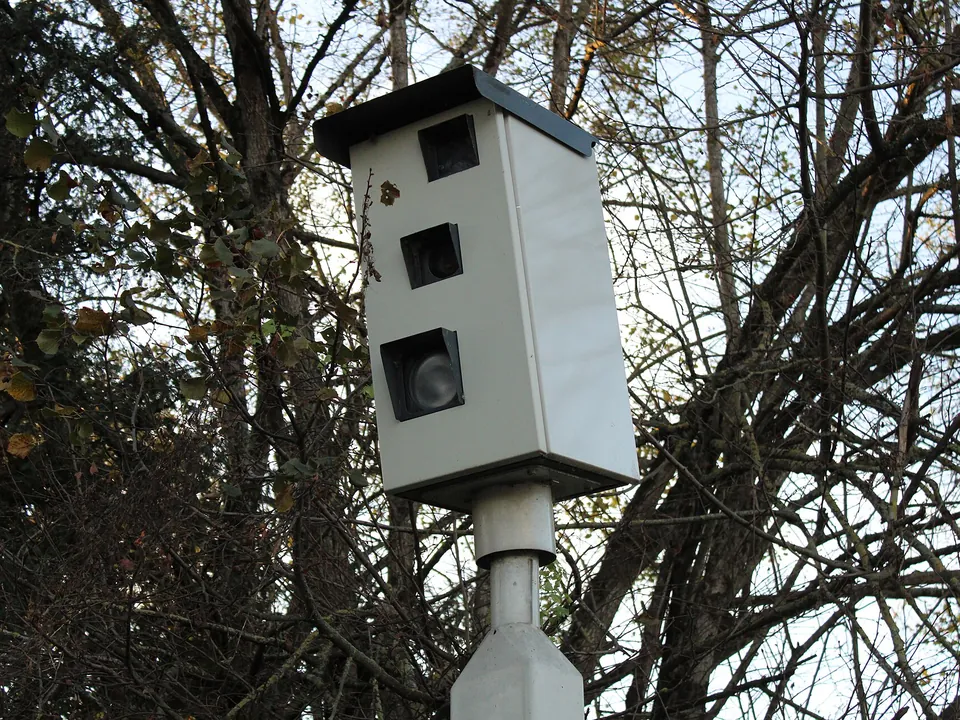
Radar fixe

Catches: Speeding. It measures each vehicle's speed as it passes, from the front or the rear, in one or both directions.

The first type installed in France, placed in the most dangerous areas. Double-face versions photograph the rear, so they also catch motorbikes.
Fixed speed camera

Signposted

Radar discriminant

Catches: Speeding by vehicle category. It tells lorries, cars and motorbikes apart, identifies the lane, and checks from the front and the rear.

It can pick out the offending vehicle when several appear in one photo.

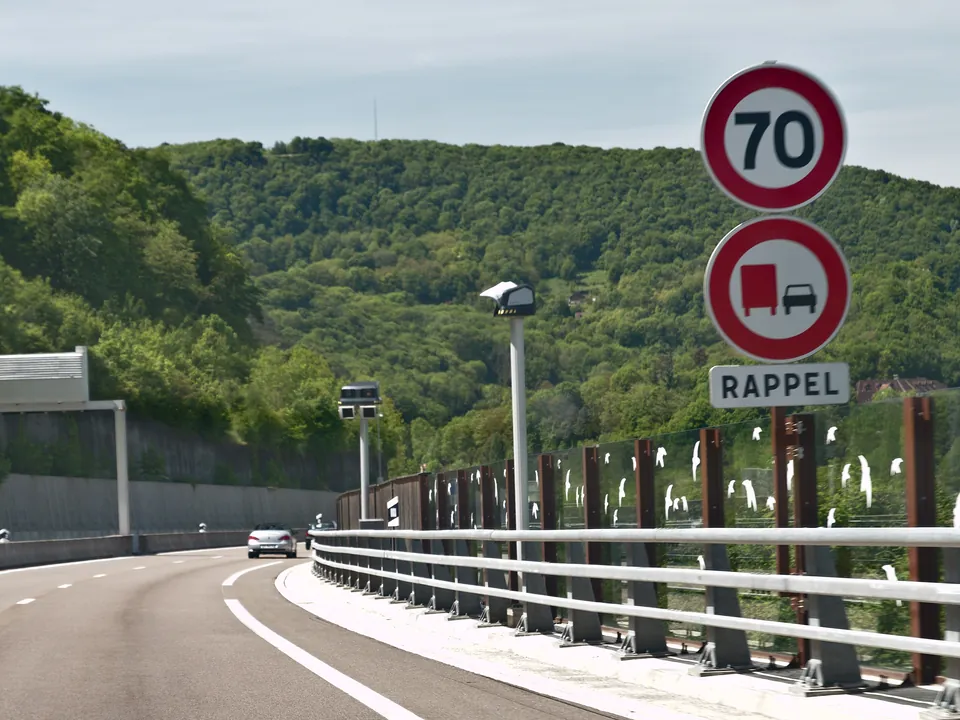
Average speed cameras on a pole beside a dual carriageway, below 70 km/h signs
RN57 approaching BesançonPhoto: Clément Eustache, CC BY-SA 4.0

Average speed camera

Signposted

Radar tronçon (radar vitesse moyenne)

Catches: Average speed over a section of road.

A camera with plate reading records each vehicle at the entry point. The offence is recorded at the exit point.

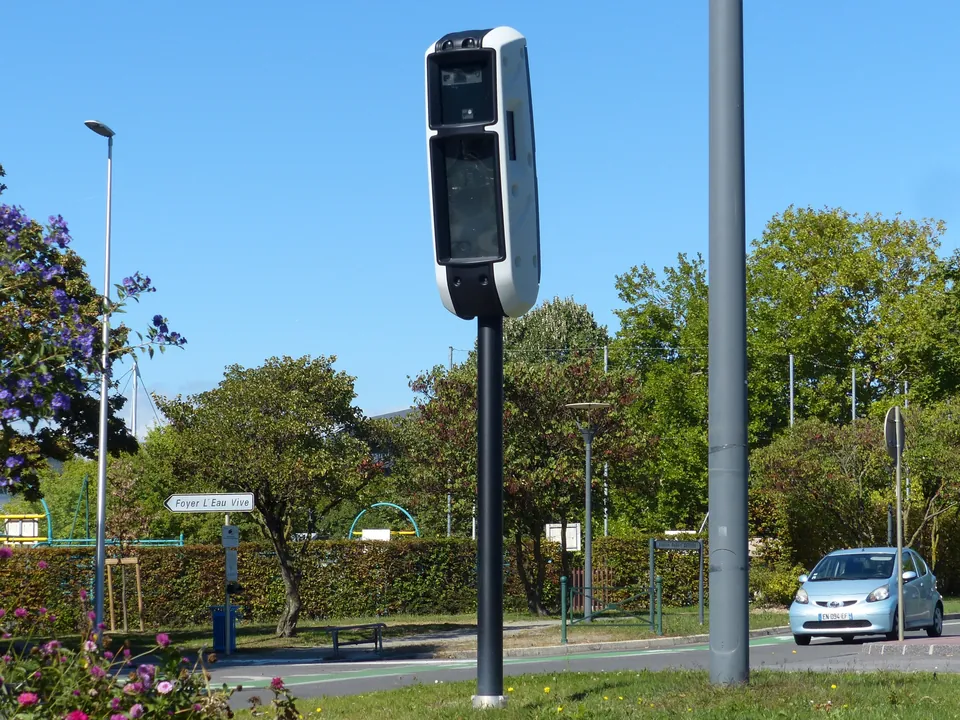
A slim speed camera on top of a tall black post beside a town road
Avenue Charles-de-Gaulle, AnnemassePhoto: Marc Mongenet, CC BY-SA 4.0

Turret camera

Radar tourelle

Looks like: A camera mounted high up on a tall post, out of reach of vandals.

Catches: Speeding in both directions and the lane used, and in some places red lights and level crossings.

The urban version (radar urbain) has the same functions, is smaller and can be fixed to street furniture.

A grey red light camera housing on a post
Avenue de Verron, La FlèchePhoto: Anthony Levrot, CC BY-SA 4.0

Red light camera

No warning

Radar feu rouge (radar de franchissement)

Looks like: Sensors set into the road at the stop line, with a camera that takes photos.

Catches: Vehicles crossing the line after the light turns red. A first photo is taken at the line and a second if the vehicle carries on.

Level crossing camera

No warning

Radar passage à niveau

Catches: Vehicles crossing a level crossing while its lights are flashing.

Works like the red light camera.

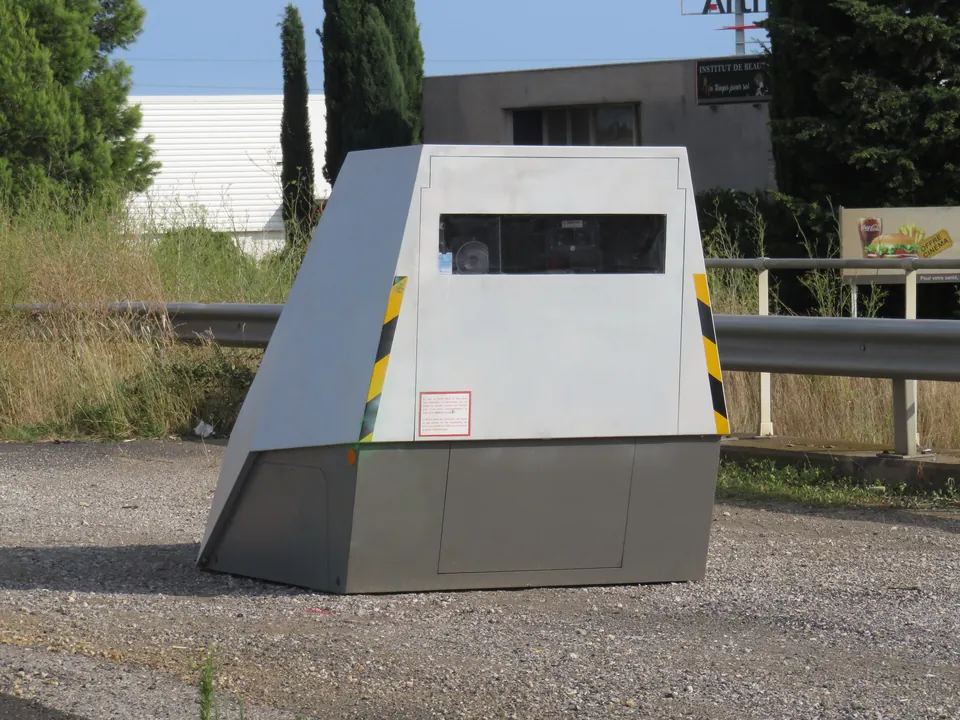
A grey movable speed camera cabin with yellow and black stripes at the roadside
D612, BéziersPhoto: Anthony Levrot, CC BY-SA 4.0

Roadworks camera

Radar autonome (radar de chantier)

Looks like: A self-contained unit that can be moved on a simple trailer.

Catches: Speeding in every direction up to 75 metres away. It tells cars and lorries apart.

Used mainly at roadworks. It runs on a battery for at least 5 days and takes about 30 minutes to set up.

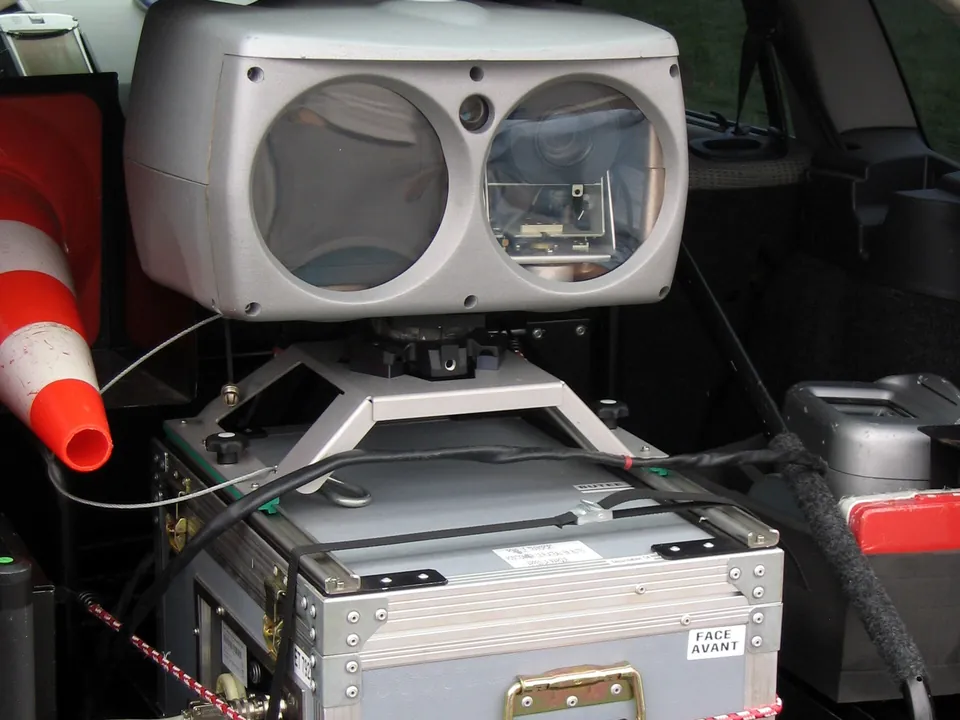
A mobile speed radar mounted in the boot of a police car
On show at Les Invalides, ParisPhoto: Thesupermat, CC BY-SA 3.0

Mobile camera

No warning

Radar mobile (radar vitesse embarqué)

Looks like: A radar in a vehicle parked at the roadside, or set up on the ground beside it.

Catches: Speeding.

Placed by police and gendarmes where speed causes crashes and at intervals on major routes.

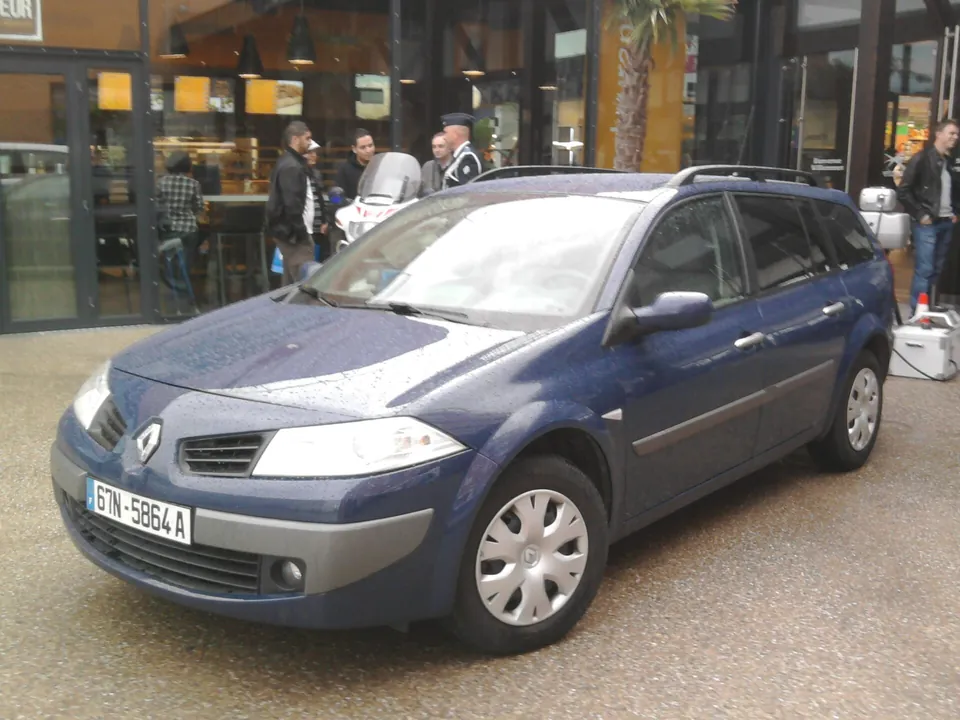
An unmarked blue Renault Mégane estate used as a radar car
A Police nationale radar carPhoto: Kevin.B, CC BY-SA 3.0

Unmarked camera car

No warning

Voiture radar

Looks like: An ordinary unmarked car in traffic, driven by gendarmes, police or a private company authorised by the state.

Catches: Speeding by vehicles around it, measured while driving. The flash is infrared, so you will not see it.

It allows a larger margin, so on a 130 km/h autoroute it flashes from 146 km/h and on a 110 km/h road from 124 km/h.

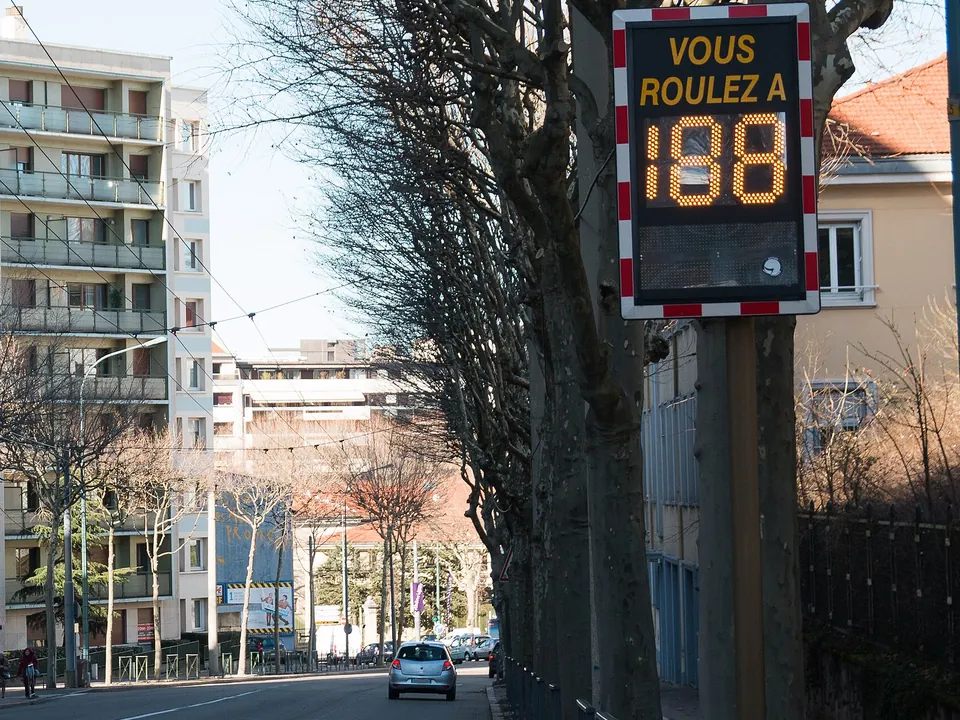
An electronic sign on a pole showing a passing driver's speed
Saint-ÉtiennePhoto: Daniel VILLAFRUELA, CC BY-SA 3.0

Speed display

Radar pédagogique

Catches: Nothing. It displays your speed and does not issue fines.

Often placed at the entrance to small towns or near schools.

The warning signs

80

Automatic speed checks ahead

Pour votre sécurité contrôles automatiques (SR3)

Fixed automatic speed cameras ahead.

What to do: Check your speed now and keep to the limit.

80

Speed camera ahead

Panneau radar (version since 2017)

A fixed speed camera ahead, and the limit it enforces.

What to do: Keep to the speed shown.

  • Rectangle with a yellow border and a grey background, with black pictograms of radar waves and vehicles. The older version (SR3) has white text reading 'Pour votre sécurité contrôles automatiques' or 'Pour votre sécurité contrôles radars fréquents'.
  • Newer version used since 1 March 2017: the same yellow border and pictograms with no text, showing the speed limit the camera enforces.
  • A sign marking the entry to a control zone, with a distance plate showing the length of the zone.

Good to know

Tolerance: Fixed and mobile radars take 5 km/h off the recorded speed below 100 km/h and 5 per cent above that, in the driver's favour. Camera cars allow 10 km/h on limits under 100 km/h and 10 per cent on higher limits.

Radar detectors: Illegal

Apps that warn of cameras: Restricted

If you're in a hire car: Camera fines are sent to the vehicle's registration holder. For a hire car that is the hire company, which gives the authorities your name from the rental contract. Depending on the contract, it may pass the fine on to you or charge it to your card, often with a handling fee of €20 to €40.

Fines

OffenceFine
Speeding by less than 20 km/h where the limit is above 50 km/h Plus 1 point on a French licence when 5 km/h or more over.€68
Speeding by less than 20 km/h where the limit is 50 km/h or lower Plus 1 point on a French licence when 5 km/h or more over.€135
Speeding by 20 to 49 km/h Plus 2 to 4 points on a French licence. From 30 km/h over, a court can also suspend the licence for up to 3 years.€135
Speeding by 50 km/h or more A criminal offence (délit). The car can be immobilised and impounded.Up to €3,750 and 3 months in prison
Running a red light Plus 4 points on a French licence and a possible suspension of up to 3 years.€135

The full guide to driving in France · Speed cameras in other countries