Driving in Japan as a Greek
In Japan you drive on the left, the opposite of Greece, so the steering wheel is on the right and you go clockwise around roundabouts. With a Greek licence you also need an International Driving Permit. At junctions without signs or road markings, traffic from your left goes first, even from a small side street.
Unless signposted otherwise, the limits are 60 km/h in towns and on country roads, and 100 on motorways. Watch for fixed and mobile cameras, and for unmarked camera cars. The alcohol limit is 0.03, lower than the 0.05 at home.
Japan and Greece side by side
The rows in yellow are different from home.
| Rule | Japan | Greece |
|---|---|---|
| Drive on the | Left | Right |
| Speed units | km/h | km/h |
| Alcohol limit | 0.03 | 0.05 |
| Holding a phone | Banned | Banned |
| Earphones | Restricted | Restricted |
| Turn on red | No | No |
| Unmarked junctions | Traffic from the left | Traffic from the right |
| Roundabouts go | Clockwise | Anticlockwise |
| Daytime headlights | When visibility is poor | Not required |
The rules that catch Greeks out
The most important first.
They drive on the left
In Japan you drive on the left. At home you drive on the right. The steering wheel is on the right, and in a manual car you change gears with your left hand. Habit puts people on the wrong side when they pull out of a car park or turn into a quiet street, so say it out loud for the first day. At junctions, the nearest traffic comes from your right, so look right first.
Roundabouts go clockwise
Roundabouts go clockwise here. At home you go anticlockwise. Give way to traffic already on the roundabout, which comes from your right, so look right as you enter.
Stop at every railway crossing
Stop before every railway crossing, at the stop line if there is one. Look both ways and listen for trains, then cross. This applies even when the barriers are up and no alarm is sounding. The only exception is a crossing with its own traffic lights showing that you can go.
The stop sign is a red triangle
Japan's stop sign is a red triangle pointing down, with 止まれ (tomare) in white. Newer signs also say STOP. Stop completely at the line and check both ways. Police enforce this strictly.
30 km/h on roads without a centre line
Since 1 September 2026, the default limit on roads without a centre line, lane lines or a central barrier is 30 km/h. Roads with them stay at 60 km/h unless signposted.
Any alcohol is illegal, and others are liable too
Do not drive after drinking any alcohol, and do not drive with a hangover. Anyone who lends you the car, gives you alcohol when you are going to drive, or asks to ride with you after you have been drinking can also be punished. The blood alcohol limit is 0.03. That's lower than the 0.05 at home.
Only a 1949 Geneva Convention IDP is valid
Japan does not accept IDPs issued under the 1968 Vienna Convention, or card and smartphone IDPs. Drivers from Switzerland, Germany, France, Belgium, Monaco and Taiwan need an official Japanese translation of their licence instead.
Stop for pedestrians at crossings
Approach pedestrian crossings at a speed that lets you stop. If anyone is crossing or about to cross, stop before the crossing and let them go. If a vehicle has stopped at a crossing, stop before you pass it.
Traffic from the left goes first at unmarked junctions
At a junction without lights or signs, give way to vehicles coming from your left. If the other road is a priority road or clearly wider, it goes first whichever side it is on. A road whose centre line runs through the junction counts as a priority road. At a junction with no signs, signals or road markings, give way to traffic coming from your left, even from a small side street. It's the opposite of home, where traffic from the right goes first.
9 more rules worth knowing
Right turns give way to oncoming traffic
When you turn right, oncoming vehicles going straight or turning left go first. Wait with your indicator on until they and any pedestrians have passed.
Give cyclists room or slow down
Since 1 April 2026, if you cannot leave enough space when passing a cyclist, you must slow to a speed that is safe for the gap. JAF recommends at least 1.5 metres, or crawling speed. Breaking the rule costs ¥7,000 and 2 points. Do not cross a solid yellow centre line to get past a cyclist. Slow down and pass within your lane.
Yellow centre line means no overtaking
A solid yellow centre line means you must not cross into the opposite lane to overtake.
Report every accident to the police
After any accident, call the police on 110, even if nobody is hurt. If someone is injured, give first aid and call an ambulance on 119.
Speed limits
Towns are 60 km/h here, faster than the 30 km/h at home. Country roads are 60 km/h here, slower than the 90 km/h at home. Motorways are 100 km/h here, slower than the 130 km/h at home.
No passing on the left
On motorways, overtaking on the left is banned. Keep to the left-hand lane unless you're overtaking. Keep to the leftmost lane. On roads with three or more lanes in your direction, you may use any lane except the rightmost one, depending on your speed.
Bus lanes in Okinawa
Most bus lanes apply from 7:30 to 9:00 and from 17:30 to 19:00 on weekdays, and some routes have other hours. They do not apply at weekends, on public holidays or on 2 and 3 January. During those hours, only buses and the other vehicles shown on the signs may use them. Where: Main roads in Naha, Urasoe and Ginowan, including parts of Route 58, Route 29, Route 222, Route 329, Route 330 and Kokusai Street. Fine: About ¥6,000 to ¥7,000. Some bus lanes are coloured green, but not all, so read the signs. You may move into a bus lane to turn left only when you are close to the junction.
Toll roads
Most expressways charge a toll based on distance. You pay at toll gates in cash, by credit card or with an ETC card. Toll lanes with a green sign take cash and credit cards. Lanes with a purple sign are for ETC cards. Hire companies can supply an ETC card. The tolls are settled when you return the car.
No turning on red
A red light means stop for every direction, including left turns. Only a green arrow lets you go, and only the way it points.
Open Japan in the app, set to a Greek licence, and keep all of this with you offline.
Open it in the appSpeed limits compared with home
The black marks show your limits at home.
Who goes first
Priority to the left
When your road has priority
Signs that look different from home
Stop
Stop completely at the stop line before the junction.
Maximum speed
Maximum speed in km/h.
Railway crossing ahead
There is a railway crossing ahead.
Pedestrian crossing
Marks a pedestrian crossing.
Speed cameras on this route
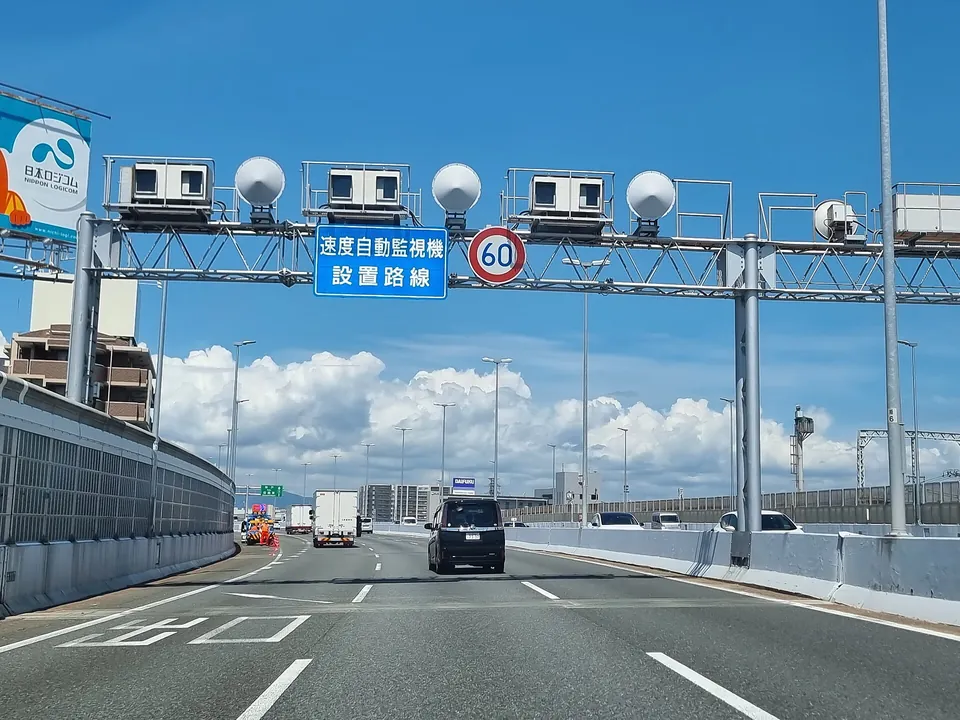
A fixed speed camera is ahead, usually 1 to 3 km away.
Signs you won't know from home
Traffic may only go in the direction of the arrow.
No parking.
No stopping or parking.
A national expressway or motor-vehicle-only road. Pedestrians, bicycles and mopeds are not permitted.
Minimum speed in km/h for motor vehicles.
Roundabout. Traffic goes round clockwise.
A school is nearby and children often use this road.
There is a junction ahead.
You may park here during the hours shown, for up to the time shown.
Speed cameras
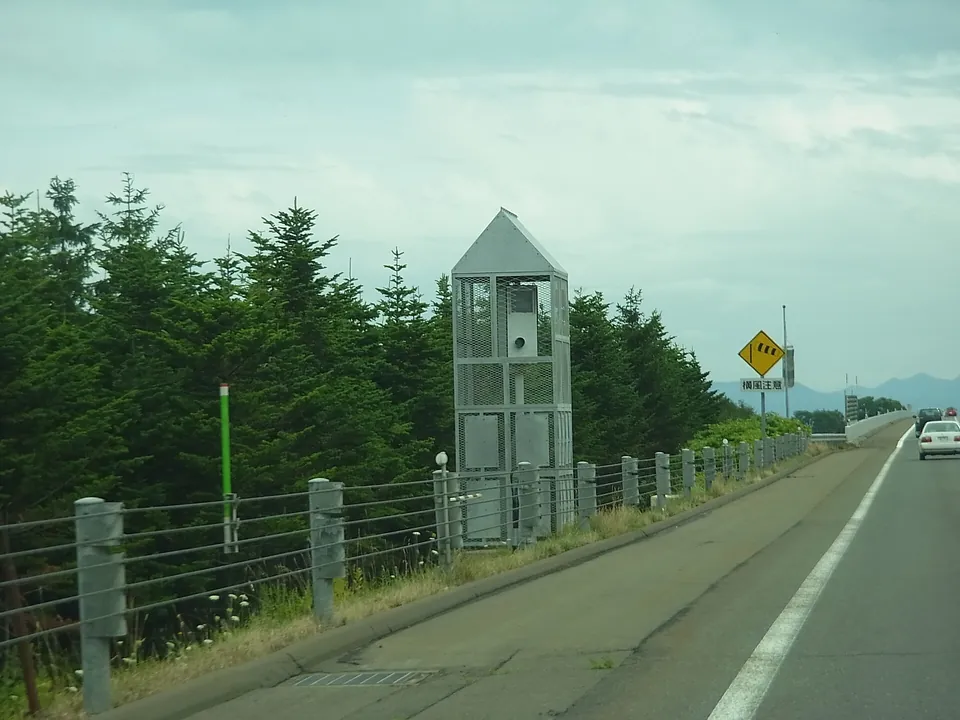
Fixed speed cameras, called Orbis, usually have warning signs 1 to 3 km before them. Portable cameras on residential roads and school routes, and police speed traps, usually do not. The camera flashes when it takes a photo. A notice goes to the registered owner, usually within days. For a hire car, the hire company has to identify the driver, which can add weeks or months.
Before you drive
- Your driving licenceThe physical card, not a photo or a digital licence.
- An International Driving PermitRequired with your licence. Get it before you leave home.
- Your passportHire companies and police ask for ID.
- Child seat for every child under 6Ask the hire company for a seat that suits the child's size. Use it in the back seat where possible if the front passenger seat has an airbag.
- Warning triangle (停止表示器材)If you have to stop on an expressway, you must place it behind the car, and turn on your hazard lights at night. On other roads, put it out if you break down at the roadside, with your hazard lights on at night.
Driving in Japan soon?
Get the before-you-drive checklist for Japan by email, with what to carry, what to check on the hire car, and the rules people get fined for.
The checklist now, one more email a few days later, and a reminder before you drive if you add the date. Unsubscribe any time.
Where Greeks drive next
Japan for drivers from elsewhere
Sources: the official Japan sources listed on the Japan guide, checked 15 October 2026.