Driving in France as a UK driver
In France you drive on the right, the opposite of the United Kingdom, so the steering wheel is on the left and you go anticlockwise around roundabouts. Your UK licence is all you need to drive in France. At junctions without signs or road markings, traffic from your right goes first, even from a small side street.
Unless signposted otherwise, the limits are 50 km/h in towns, 80 on country roads and 130 on motorways (110 in the rain), or about 31, 50 and 81 mph. Watch for fixed, mobile, average speed and red light cameras, and for unmarked camera cars. The alcohol limit is 0.05, lower than the 0.08 at home. Earphones and headphones are banned while driving.
France and the United Kingdom side by side
The rows in yellow are different from home.
| Rule | France | United Kingdom |
|---|---|---|
| Drive on the | Right | Left |
| Speed units | km/h | mph |
| Alcohol limit | 0.05 | 0.08 |
| Holding a phone | Banned | Banned |
| Turn on red | No | No |
| Unmarked junctions | Traffic from the right | No fixed rule |
| Roundabouts go | Anticlockwise | Clockwise |
| Passing on the inside | Banned | Only in slow traffic |
The rules that catch UK drivers out
The most important first.
They drive on the right
In France you drive on the right. At home you drive on the left. The steering wheel is on the left, and in a manual car you change gears with your right hand. Habit puts people on the wrong side when they pull out of a car park or turn into a quiet street, so say it out loud for the first day. At junctions, the nearest traffic comes from your left, so look left first.
Roundabouts go anticlockwise
Roundabouts go anticlockwise here. At home you go clockwise. Give way to traffic already on the roundabout, which comes from your left, so look left as you enter. Some older roundabouts have no give-way signs or markings at the entries. There, drivers on the roundabout must slow down and let entering traffic in.
Priority to the right
At a junction with no signs, lights or markings, traffic coming from your right goes first, even from a small side street. A red-bordered triangle with a black X warns of such a junction. On roads with yellow diamond signs you have priority until a diamond crossed by a black bar. At home there's no fixed rule at unmarked junctions.
Nothing in your ears
Drivers may not wear anything in or on the ear that plays sound, including a single earbud or a Bluetooth headset, even for calls. Use the car's built-in system instead. The fine is €135.
Lower limits in the rain
In rain or other precipitation the limits drop to 110 km/h on autoroutes and 100 km/h on divided roads. When visibility is under 50 metres the limit is 50 km/h on every road.
Unmarked camera cars
Ordinary-looking cars, some driven by private companies, measure the speed of traffic around them while driving. Their flash is infrared, so you will not see it. They allow a margin of 10 km/h or 10 per cent.
50 km/h over is a crime
Driving 50 km/h or more over the limit is a criminal offence (délit) from the first time, with a fine of up to €3,750, up to 3 months in prison and possible confiscation of the car.
Drink driving
The blood alcohol limit is 0.05, and 0.02 for drivers on a probationary licence (permis probatoire), which is a first licence, usually held for 3 years or less, or one obtained again after cancellation. Learners in supervised driving have the same limit. That's lower than the 0.08 at home. The standard limit is 0.5 g/L of blood, or 0.25 mg/L of breath. The novice limit is 0.2 g/L of blood, or 0.10 mg/L of breath.
Paris Centre limited traffic zone (ZTL)
Driving through the zone without stopping is banned 24 hours a day, 7 days a week. You may drive in if your trip starts or ends inside the zone. Where: Paris Centre, which is the 1st, 2nd, 3rd and 4th arrondissements. The Grands Boulevards on the north side, the Île de la Cité, the Île Saint-Louis and the right-bank quays in the west to east direction are outside the zone. Fine: None yet. On 28 September 2026 the city said no fines were being issued during a teaching phase. Plan your route around the zone unless your trip starts or ends inside it.
11 more rules worth knowing
Paris has its own limits
Most Paris streets are 30 km/h and the boulevard périphérique is 50 km/h. At weekday peak times its left lane is reserved for vehicles carrying at least two people when a white diamond is lit. Through traffic is banned in the 1st to 4th arrondissements.
Camera apps yes, detectors no
Phone and GPS apps may warn of danger zones, but not of exact camera positions. Radar detectors are illegal, with a fine of up to €1,500, and the device is seized.
Speeds are in km/h
Speed signs and your speedometer's main scale are in kilometres per hour. 50 km/h is about 31 mph, 80 km/h is about 50 mph, 130 km/h is about 81 mph.
Speed limits
Country roads are 80 km/h (about 50 mph) here, slower than the 60 mph at home. Motorways are 130 km/h (about 81 mph) here, faster than the 70 mph at home. The sign with the town's name on it sets the town limit by itself, usually with no speed sign. Limits drop when it rains.
No passing on the right
On motorways, overtaking on the right is banned. Keep to the right-hand lane unless you're overtaking. Overtake on the left.
Crit'Air low emission zones (ZFE-m)
A Crit'Air sticker is compulsory to drive in a ZFE-m, and each zone bans older vehicles by sticker class on its own timetable. In Greater Paris, cars without a sticker or with Crit'Air 5, 4 or 3 cannot drive from Monday to Friday, 8am to 8pm, except on public holidays. Parliament voted to abolish the zones, but the Constitutional Council struck that out on 21 May 2026, so they remain in force. Where: 25 urban areas, including Greater Paris, Lyon, Grenoble, Strasbourg, Lille, Montpellier, Toulouse, Aix-Marseille, Nice, Rouen and Bordeaux. Entry is marked by a zone sign (B56). Fine: €68 fixed fine, up to €450. Check that the hire car shows a Crit'Air sticker on the windscreen. For a foreign-registered car, order the sticker only from certificat-air.gouv.fr, the one official site.
Winter equipment zones (Loi Montagne)
From 1 November to 31 March, cars must have four winter tyres with the alpine symbol, or carry snow chains or snow socks for at least two driving wheels. Where: Designated communes in the Alps, Corsica, the Massif Central, the Jura, the Pyrenees and the Vosges, marked by entry and exit signs (B58 and B59). Ask the hire company for winter tyres or chains if you will drive into the mountains in winter.
Toll roads
Many autoroutes charge a toll. Most are paid at toll plazas, but the A79 and the Paris to Normandy A13 and A14 use free-flow tolling with no barriers. On free-flow sections, cameras and sensors record your plate when you enter and leave. Signs warn you about 2.5 km before the entrance. Without a toll tag, pay within 3 days of the trip on the operator's website (Aliae for the A79, Sanef for the A13 and A14) or by card or cash at a shop in the Nirio network. If you don't, fines of €90 and then €375 follow.
Your British licence is enough
With a British licence, your own licence is enough. You don't need an International Driving Permit. A UK photocard licence can be used without an IDP or translation. Holders of an old paper licence may need a photocard licence or an IDP.
No turning on red
A red light means stop, whichever way you are turning. You may only pass a red light when a flashing amber arrow beside it points the way you are going. Running a red light costs €135, and red light cameras are never signposted.
Vest and triangle in the car
Every car must carry a hi-vis vest and a warning triangle. Wear the vest when you get out after a breakdown, and place the triangle at least 30 metres behind the car.
Open France in the app, set to a UK licence, and keep all of this with you offline.
Open it in the appSpeed limits compared with home
Signs here are in km/h. The black marks show your limits at home, converted.
Who goes first
Priority to the right
When your road has priority
Signs that look different from home
Give way
Give way to traffic on the road you are joining. You do not have to stop if the way is clear.
Roundabout ahead
Roundabout ahead. Where the entry has give-way signs, traffic already on the roundabout has priority.
Speed limit
Maximum speed in km/h.
Automatic speed checks ahead
Fixed automatic speed cameras ahead.
30 km/h zone
Entry to a zone where the limit is 30 km/h on every street until an exit sign.
Signs you won't know from home
A junction ahead where you must give way to traffic coming from your right.
You are on a priority road. Traffic from side roads must give way to you at every junction.
End of the priority road.
Start of a built-up area. The 50 km/h limit applies from here unless signs show otherwise.
End of the built-up area and of the 50 km/h urban limit.
At the next junction, traffic from the side road must give way to you.
Start of a restricted-access road.
End of the restricted-access road.
Speed cameras
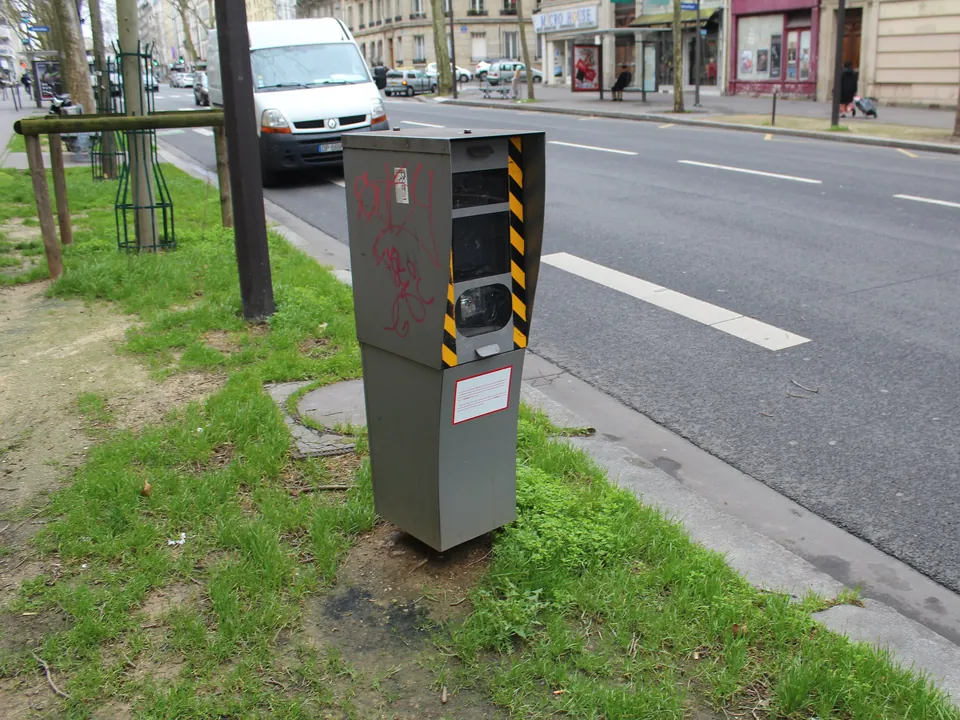
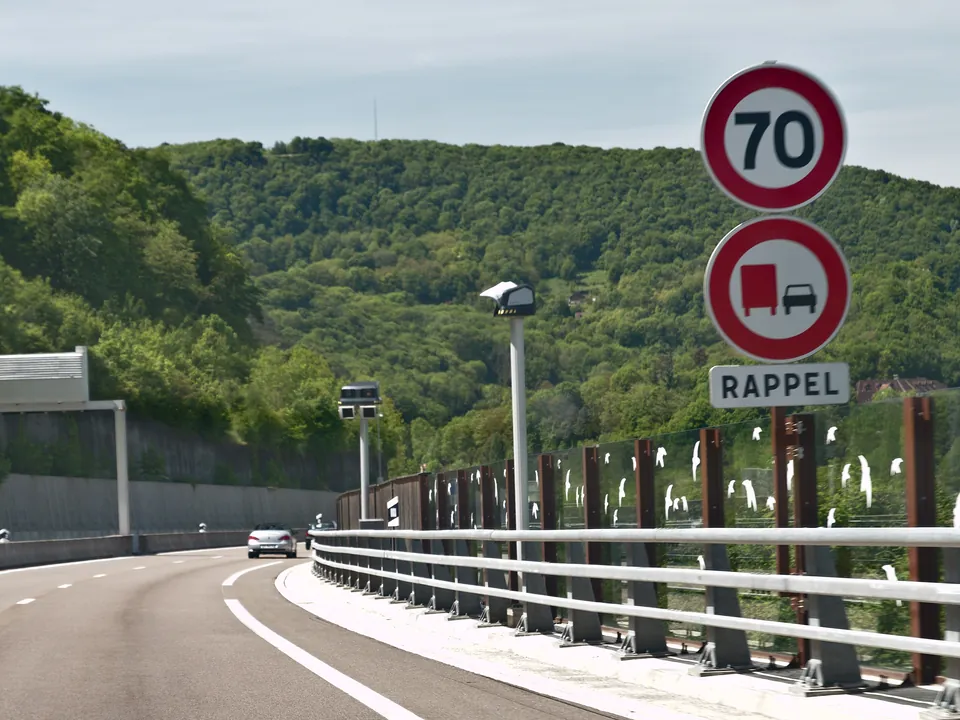
Fixed speed cameras are usually announced by signs, although the law does not require it. Red light and level crossing cameras, mobile radars and unmarked camera cars are never announced. Camera fines are sent to the vehicle's registration holder. For a hire car that is the hire company, which gives the authorities your name from the rental contract. Depending on the contract, it may pass the fine on to you or charge it to your card, often with a handling fee of €20 to €40.
Before you drive
- Your driving licenceThe physical card, not a photo or a digital licence.
- Your passportHire companies and police ask for ID.
- Hi-vis vestWear it when you get out after a breakdown or emergency stop. Not carrying one costs a €135 fixed fine.
- Warning trianglePlace it at least 30 metres behind the car. Not carrying one costs a €135 fixed fine.
- Crit'Air low emission zones (ZFE-m)Check that the hire car shows a Crit'Air sticker on the windscreen. For a foreign-registered car, order the sticker only from certificat-air.gouv.fr, the one official site.
- Earphones awayCalls and directions through the car's speakers.
Driving in France soon?
Get the before-you-drive checklist for France by email, with what to carry, what to check on the hire car, and the rules people get fined for.
The checklist now, one more email a few days later, and a reminder before you drive if you add the date. Unsubscribe any time.
Where UK drivers drive next
France for drivers from elsewhere
Sources: the official France sources listed on the France guide, checked 15 October 2026.