Driving in Germany as a UK driver
In Germany you drive on the right, the opposite of the United Kingdom, so the steering wheel is on the left and you go anticlockwise around roundabouts. Your UK licence is all you need to drive in Germany. At junctions without signs or road markings, traffic from your right goes first, even from a small side street.
Unless signposted otherwise, the limits are 50 km/h in towns and 100 on country roads, or about 31 and 62 mph. Some stretches of motorway have no general limit, with 130 km/h recommended. Watch for fixed, mobile and red light cameras, and for unmarked camera cars. The alcohol limit is 0.05, lower than the 0.08 at home.
Germany and the United Kingdom side by side
The rows in yellow are different from home.
| Rule | Germany | United Kingdom |
|---|---|---|
| Drive on the | Right | Left |
| Speed units | km/h | mph |
| Alcohol limit | 0.05 | 0.08 |
| Holding a phone | Banned | Banned |
| Turn on red | Only where signposted | No |
| Unmarked junctions | Traffic from the right | No fixed rule |
| Roundabouts go | Anticlockwise | Clockwise |
| Daytime headlights | When visibility is poor | When visibility is poor |
| Passing on the inside | Only in slow traffic | Only in slow traffic |
The rules that catch UK drivers out
The most important first.
They drive on the right
In Germany you drive on the right. At home you drive on the left. The steering wheel is on the left, and in a manual car you change gears with your right hand. Habit puts people on the wrong side when they pull out of a car park or turn into a quiet street, so say it out loud for the first day. At junctions, the nearest traffic comes from your left, so look left first.
Roundabouts go anticlockwise
Roundabouts go anticlockwise here. At home you go clockwise. Give way to traffic already on the roundabout, which comes from your left, so look left as you enter. Traffic on the roundabout has priority only where a give way sign stands with the blue roundabout sign. A circular junction without a give way sign follows priority to the right, so traffic entering it goes first.
Priority to the right (rechts vor links)
At junctions with no signs, lights or markings, traffic from the right goes first, even from a small side street and even at T-junctions. Unless a sign such as the yellow diamond gives you priority, assume traffic from the right goes first. At home there's no fixed rule at unmarked junctions.
No general speed limit on the Autobahn
Where no limit is signposted, cars have no speed limit and 130 km/h is only advised. Traffic can come up behind you very fast, so check your mirrors early and signal before you pull out. Signposted limits, including electronic ones, are enforced.
Emergency corridor (Rettungsgasse)
As soon as traffic on the Autobahn or another road with two or more lanes each way slows to walking pace or stops, you must leave a corridor for emergency vehicles. It goes between the far left lane and the lane next to it: drivers in the left lane move left, everyone else moves right. Not doing so costs €200, a 1-month ban and 2 points.
Never pass on the right
Overtake only on the left, even if a slow car sits in the left lane. Passing on the right is allowed only when the left lane is queuing or crawling. Outside towns it costs €100 and 1 point.
No stopping, turning or reversing on the Autobahn
Stopping on the Autobahn is banned, including on the hard shoulder, except in an emergency or breakdown. Turning round and reversing are banned too, even if you miss your exit. Reversing on the carriageway costs €200, a 1-month ban and 2 points.
Turning across cyclists
When you turn, you must let cyclists going straight on through, including those on a cycle path beside the road. Check your mirror and over your shoulder before every turn.
Winter tyres depend on the weather, not the date
If the road is icy, snowy or slushy, you must have winter tyres with the Alpine symbol, whatever the date. Check that a hire car in winter has them.
Drink driving
The blood alcohol limit is 0.05, and zero for drivers under 21, and drivers in the 2-year probationary period of a German licence. That's lower than the 0.08 at home. The limit is 0.5 per mille in blood or 0.25 mg/l in breath.
10 more rules worth knowing
Camera warnings are illegal
Radar detectors and the camera-warning function of a phone app or sat nav are banned. A court has ruled that a passenger may not run such an app either. The fine is €75 and 1 point, and police can seize a radar detector. Radio traffic reports that mention cameras are allowed.
Green arrow on red
Right turns on red are banned unless a small green arrow sign is fixed beside the light. Even then you must stop completely first and give way to everyone.
Buses at stops with hazard lights on
You may pass a bus or school bus that is stopped at a stop with its hazard lights on only at walking pace. This applies to oncoming traffic too. You may not overtake a bus approaching a stop with its hazard lights on.
Traffic-calmed areas
A blue sign showing people, a child playing and a car marks a traffic-calmed area. Drive at walking pace, let pedestrians use the whole street and park only in marked bays.
Speeds are in km/h
Speed signs and your speedometer's main scale are in kilometres per hour. 50 km/h is about 31 mph, 100 km/h is about 62 mph.
Speed limits
Some stretches of motorway have no general limit. 130 km/h is the recommended maximum, and many sections are signposted lower. The sign with the town's name on it sets the town limit by itself, usually with no speed sign.
What the car must carry
The car must carry a warning triangle, a hi-vis vest, a first aid kit and winter tyres (in winter). Hire cars should have them, but check before you drive away, because the driver gets the fine.
Umweltzonen (low emission zones)
Only vehicles with a green Umweltplakette sticker on the windscreen may enter. The rule also applies to foreign-registered vehicles. Where: 35 zones as of August 2026, including Berlin, Munich, Frankfurt am Main, Cologne, Düsseldorf, Stuttgart, Bremen, Leipzig and one zone covering 13 cities of the Ruhr. Hannover, Freiburg and Mainz lifted their zones in 2024 and 2025. Fine: €100. Check that a hire car has the green sticker on the inside of the windscreen before you drive into a city. If you bring your own car, order the sticker online before you travel. It costs about €5 to €20.
Diesel driving bans
Older diesel cars are banned. Euro 4 and older diesels may not enter the Munich low emission zone or use the Mittlerer Ring, and may not enter the Stuttgart zone. In Stuttgart's small inner zone, Euro 5 diesels are banned too. Darmstadt bans Euro 5 and older diesels on Hügelstraße and Heinrichstraße. Where: Munich, Stuttgart and two streets in Darmstadt. Fine: €100 plus fees. Euro 6 diesels are not affected. Check the emission class if you are offered an older diesel.
Your British licence is enough
With a British licence, your own licence is enough. You don't need an International Driving Permit. The UK government says a UK photocard licence is enough for stays of up to 6 months. For longer stays you also need a 1968 IDP, which can only be bought in the UK.
Open Germany in the app, set to a UK licence, and keep all of this with you offline.
Open it in the appSpeed limits compared with home
Signs here are in km/h. The black marks show your limits at home, converted.
Who goes first
Priority to the right
When your road has priority
Signs that look different from home
Give way
Give way to traffic on the road you are entering.
30 km/h zone
A 30 km/h limit applies on every street in the zone until the end-of-zone sign.
Roundabout
Roundabout. When it stands with a give way sign, traffic already on the roundabout has priority.
Railway crossing
Railway crossing. Trains have priority.
Signs you won't know from home
You are on a priority road. Traffic from side roads must give way to you at every junction.
Your priority ends. Priority to the right applies at the next junction without signs.
At the next junction, traffic from the right has priority.
You have priority at the next junction only.
You are entering a built-up area. The 50 km/h limit starts at this sign, with no speed sign needed.
You are leaving the built-up area. The 50 km/h urban limit ends.
All signposted speed limits and overtaking bans on this stretch end.
Low emission zone. Only vehicles displaying a sticker of a colour shown on the plate may enter. All current zones admit only the green sticker.
You may turn right while the light is red, after stopping.
Speed cameras
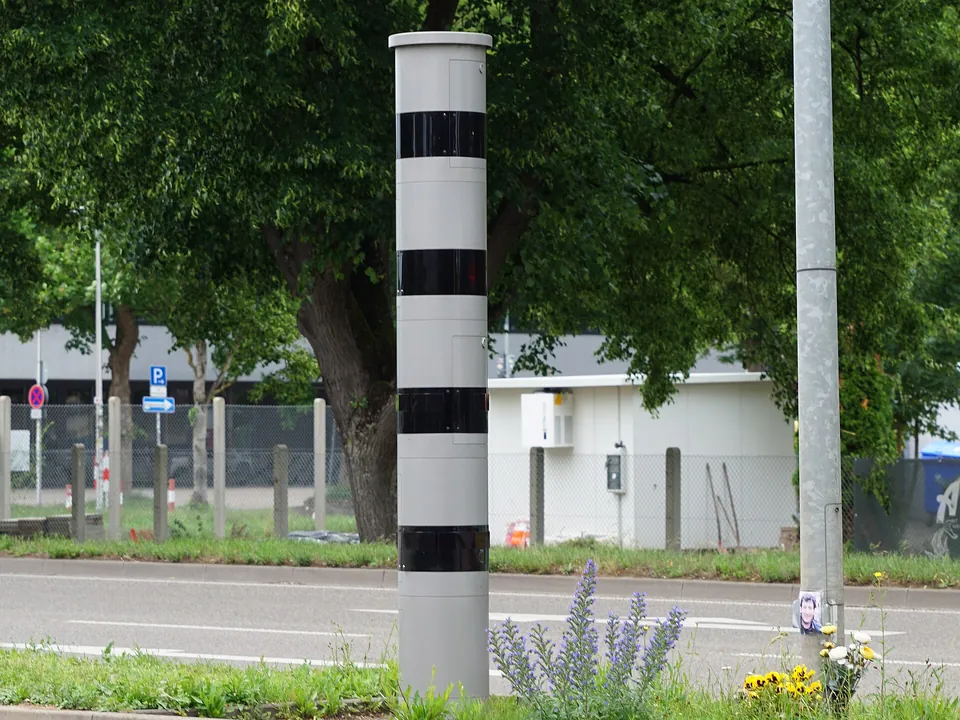
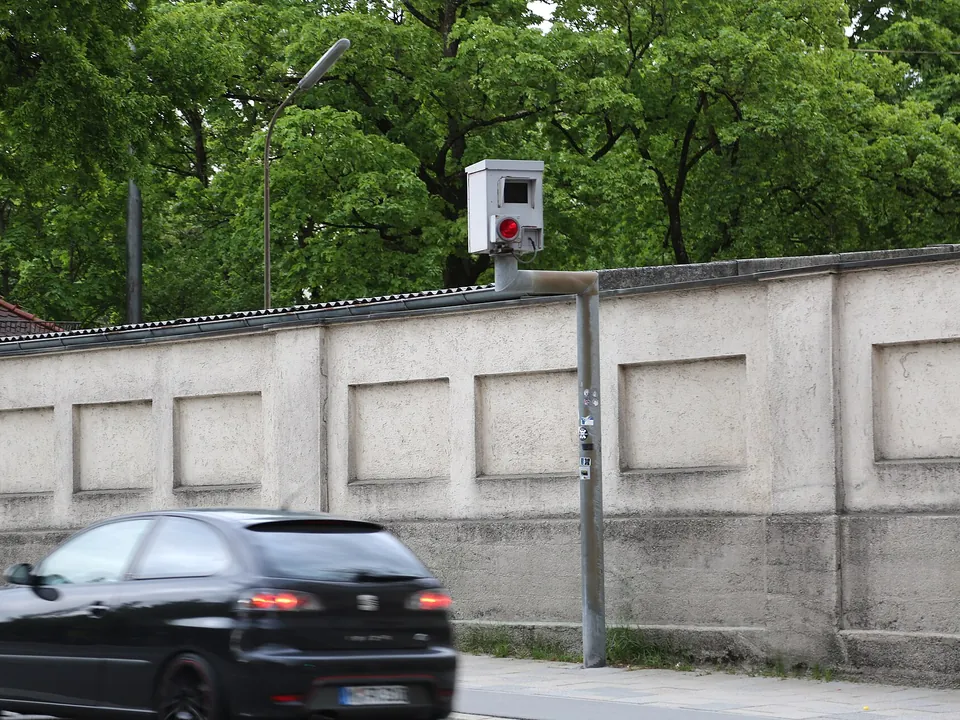
Germany uses fixed speed cameras, mobile cameras, red light cameras and unmarked police cars that film from behind. There is no official camera warning sign. Radar detectors and camera-warning apps are illegal. Section control has only been used on one stretch of the B6 near Hanover, which was reported switched off in January 2024. Camera fines go to the registered keeper. For a hire car that is the hire company, which passes your details to the authority and may charge an admin fee, and the fine is then sent to you. For cars registered elsewhere in the EU, Germany obtains the keeper's details through the EU exchange system and writes in the language of the registration document. Since 1 July 2026 the authorities have 6 months, instead of 3, to start proceedings, so a fine can arrive months after your trip.
Before you drive
- Your driving licenceThe physical card, not a photo or a digital licence.
- Your passportHire companies and police ask for ID.
- Warning triangleRequired in every car. At a breakdown on a fast road, switch on the hazard lights first, then place the triangle about 100 m behind the car.
- Hi-vis vestAt least one vest is required in every car.
- First aid kitA kit meeting the DIN 13164 standard, kept in a container that protects it from dust and damp. The fine for not carrying one is €5.
- Umweltzonen (low emission zones)Check that a hire car has the green sticker on the inside of the windscreen before you drive into a city. If you bring your own car, order the sticker online before you travel. It costs about €5 to €20.
- Diesel driving bansEuro 6 diesels are not affected. Check the emission class if you are offered an older diesel.
Driving in Germany soon?
Get the before-you-drive checklist for Germany by email, with what to carry, what to check on the hire car, and the rules people get fined for.
The checklist now, one more email a few days later, and a reminder before you drive if you add the date. Unsubscribe any time.
Where UK drivers drive next
Germany for drivers from elsewhere
Sources: the official Germany sources listed on the Germany guide, checked 15 October 2026.